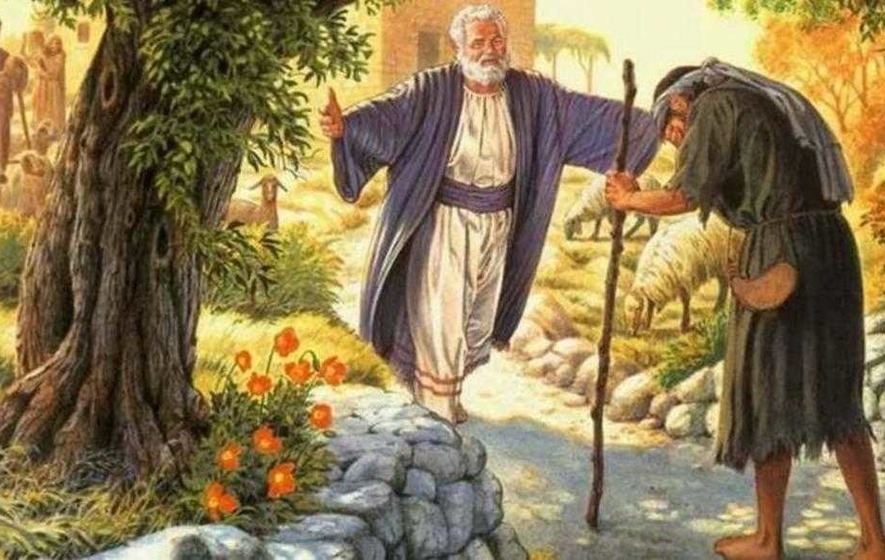
The Parable of the Brother Everyone Forgot

In Luke 15, Jesus tells a series of “lost” parables to an audience consisting of sinners/tax collectors and Pharisees/scribes. First comes the parable of the lost sheep, where a man loses a sheep out in the wilderness and rejoices when it is found. Next comes the parable of the lost coin, where a woman loses a coin in her home and rejoices when it is found.

Then we come to a parable about a man with two sons. The younger son wants his inheritance, so the father divides up his assets, giving one-third to the younger son and two-thirds to the older son. The younger son takes off and squanders his inheritance with riotous living. When an unexpected famine strikes, the younger son becomes destitute and shamefully returns home, offering to become his father’s servant because he is not worthy of his father’s love. However, in a completely unexpected turn of events, the father runs out to meet him, falls on his neck, and kisses him. The father then throws a party for his returned son, for “he was lost and now is found.”

We all know this story. A man with a lost son out in the wilderness, who rejoices when he is found. What we often overlook is the end of the story, which focuses on the other lost son—the lost son who never left home.

The older brother is working in the field when his younger brother returns home. Instead of rejoicing with his father at the return of his brother, he throws a giant fit. He refuses to celebrate. He refuses to even call him his brother. And he thinks the worst of his brother, exclaiming without evidence that his brother had wasted the money on whores.

With all this in mind, let’s consider what a first century Jew would’ve thought when hearing this parable. Consider a few elements from the tale: a father with two sons, brothers squabbling over an inheritance, the younger brother leaving town with his blessing, the older brother working out in the field.

In the mind of a Jewish listener, this story would immediately call to mind the story of Esau and Jacob. The younger Jacob stole his older brother Esau’s inheritance while Esau was out working in the field, and then left town. In fact, there are many parallels throughout these two stories:

Isaac has two sonsFather has two sons
Jacob steals Esau’s inheritanceYounger brother receives his inheritance
Jacob goes to Padan AramYounger brother goes to a far country
There is a famine after Jacob tricks EsauThere is a famine after younger brother leaves
Jacob meets Esau and offers to be his servantYounger brother offers to be his father’s servant
Jacob tells God “I’m not worthy of your mercies”Younger brother tells father “I am no longer worthy to be called your son”
Esau runs, falls on neck, and kisses JacobFather runs, falls on neck, and kisses younger brother
Jacob had stolen inheritance while Esau was in the fieldYounger brother returns home while older brother is in the field

Any person familiar with the biblical text would notice the similarities between the two narratives. But they also would notice a few key differences:

For one, the younger brother in the parable didn’t steal his brother’s inheritance; rather he prematurely requested his own inheritance. Notice that when the younger brother received his one-third inheritance, the older brother also received his two-thirds inheritance (Luke 15:12). The younger brother didn’t actually steal anything from his older brother.

Also, notice that in the Esau-Jacob narrative, it is Esau who lovingly welcomes home his brother. He is no longer bitter; instead he is happy to receive his brother home, and doesn’t require any of the gifts Jacob had sent to appease him. Compare that to the lost older brother, who—despite having twice as much as his sibling—refuses to welcome him home.

The message to Jesus’ first century audience was clear: Those who behave like the older brother are worse than Esau. Those lost coins who have remained in their master’s home but are still nevertheless lost, those Pharisees/scribes who rejected the lost sheep rather than welcomed them—they are like those who despised their birthright, who rejected their inheritance, who turned their backs on their God and Father.

In fact, the behavior of the older brother might call to mind another older brother: Cain, who led his younger sibling out into a field where he murdered him, then disinherited him (“Am I my brother’s keeper?”).

At the time Jesus spoke these words, a man named Herod was reigning as the King of the Jews. And yet, he wasn’t Jewish. He was Idumean—an Edomite, a descendant of Esau—appointed by the oppressive Roman Empire to rule over the Jews. To the Jews, Herod was Esau-Incarnate—an imposter king who had despised the inheritance of the Jews and yet wanted to wield it over the Jews. And according to Jesus, the religious elite were just as bad as he was. And by the end of the gospels, those same religious leaders would be working with this imposter king to rid their nation of the true King of the Jews, the Heir of Jacob and the Finder of Sheep and Coins and Sons.

The resounding message, to those who heard this in the first century and those of us who read it in the twenty-first century, is clear. Those of us in the LORD’s house should partner with our Father to find the lost sheep without and the lost coins within. We should rejoice when the lost sheep are found. We should rejoice when the lost coins are found. And if our hearts want to throw a fit while the angels are throwing a party, we may not be as found as we think.

“It was right that we should make merry and be glad, for your brother was dead and is alive again, and was lost and is found.” (Luke 15:32)

Special thanks to the lectures of Peter J. Williams, whose series “The Genius of Jesus’ Teachings” brought to light many of these parallels. If you appreciated this article, you should definitely watch his teachings on this parable.

The Selfish King who was Accidentally Right

Our family started reading the Book of Esther today. The story begins with the King of Persia ordering his wife to come entertain his drunk buddies and her refusing. The king’s wisest counselors fear that other wives will disobey their husbands’ demands if the queen isn’t dealt with, so she is banished. The chapter ends with the king issuing a royal decree: “Each man shall be head in his own house.” 

Here’s the thing: The king was right… sort of. Every man should be the head of his household. Wives should honor and follow their husbands. The king and his counselors were right. But they wanted to wield this role selfishly, rather than selflessly. 

The man isn’t called to lead so he can have whatever he wants. He’s called to lead so he can serve and protect his household. The man leads by discipling his family, as Moses said (Deut. 6). The man leads by loving and sacrificing, as Paul said (Eph. 5). The man leads by serving, as Jesus said (Matt. 20). 

The king and his counselors wanted the benefits of their position, but they didn’t want the responsibilities. They wanted to be leaders, but they didn’t want to lead. 

It’s noteworthy that in the second chapter of Esther, we are introduced to a man—Mordecai—who spends the entire book serving and protecting others. And by the end of the book, the king’s wise counselors are replaced by this Mordecai, as the book concludes: 

Mordecai the Jew was second to the king… seeking the good of his people and speaking peace to all his countrymen.” 

If you want to be “head of your own house,” follow Mordecai’s example. “Seek the good of your people.” 

How Joel Learned Grace from a Wicked King and a Wayward Prophet

Throughout the Hebrew Scriptures, God repeatedly reveals Himself as “The LORD God, merciful and gracious, slow to anger, abounding in goodness and TRUTH.” (Exodus 34:6, Psalm 86:15, Psalm 103:8, Psalm 145:8, Nehemiah 9:17)

Centuries later, right before the wicked city of Nineveh is to be destroyed, the Ninevite king and his people repent of their sin and cry out, “Who can tell if God will turn and RELENT, and turn away from His fierce anger, so that we may not perish?” (Jonah 3:8)

God does relent and forgives their sins… which makes Jonah quite angry. He screams at God, and then quotes Exodus 34 back to Him… almost:

“You are a gracious and merciful God, slow to anger, abounding in goodness, ONE WHO RELENTS FROM DOING HARM.” (Jonah 4:2)

Notice the change? In Jonah’s eyes, God does not abound in truth. For the truthful thing, according to Jonah, would have been to destroy the wicked city whose sins had rightfully earned them their deserved destruction. It’s no coincidence that we are introduced to Jonah as “Jonah the son of Amattai”—the son of MY TRUTH. Jonah’s truth was that justice and mercy couldn’t go hand-in-hand, and as such God’s willingness to relent and forgive contradicted His claim of abundant truth.

If we’re not careful, many of us will end up viewing the world like Jonah: Angry that wicked people aren’t getting what we think they deserve, mad that God isn’t doling out our version of justice, unwilling to forgive those who have harmed those we care about.

Or we can take another path: The path of Joel, who quoted from Jonah a few centuries later. Joel, too, misquoted Exodus’ description of God—or rather, directly quoted Jonah’s altered description:

“Return to the LORD your God, for He is gracious and merciful, slow to anger, abounding in goodness, and ONE WHO RELENTS FROM DOING HARM.” (Joel 2:13)

But whereas Jonah was angry that God didn’t dole out the justice the wicked truthfully deserved, Joel is crying out that God would instead overlook His own people’s true wickedness and give them mercy instead. In his desperation for God’s people to return to the LORD, Joel even goes so far as to quote the wicked king of Nineveh:

“Who knows if He will turn and RELENT, and leave a blessing behind Him.” (Joel 2:14)

As the world seems to get more and more wicked, let’s approach others with the heart of Joel rather than Jonah. Let’s pray that they would repent and return to the LORD, rather than that God would strike down our enemies with fire and brimstone.

Whereas Jonah was blind to his own wickedness and desired vengeance on the wicked, Joel was well aware of the sins of Israel, and prayed that the people would repent and that God would relent.

As the world seems to get more and more wicked, let’s approach others with the heart of Joel rather than Jonah. Let’s pray that they would repent and return to the LORD, rather than that God would strike down our enemies with fire and brimstone.

Men of Chayil (Exodus 18:21)

(from Ramban’s Commentary on the Torah)

MEN OF ‘CHAYIL.’ This means men who are capable of leading a great multitude of people. Every assembly and gathering is called chayil, and it does not apply only to soldiers going forth to war. Thus it is said [of the dry bones that Ezekiel resurrected], a great ‘chayil’ (host) (Ezekiel 37:10). Of the locusts it is said, My great ‘chayil’ (army) (Joel 2:25). Of wealth it is stated, My power and the might of my hand hath gotten this ‘chayil’ (wealth) (Deuteronomy 8:17); they carry upon the shoulders of young asses ‘chayaleihem’ (their riches).105Isaiah 30:6. Of fruits it is said, the fig-tree and the vine do yield ‘cheilam’ (their strength).106Joel 2:22. Thus an ish chayil in the administration of justice is one who is wise, alert, and fair; in war, an ish chayil is one who is strong, alert, and who knows the art of arraying forces in battle. A woman also is an eisheth chayil (a woman of valor)107Proverbs 31:10. when she is alert and knows how to conduct the management of a home.

Jethro thus spoke in general and in particular. [In general], he told Moses to select people with powers of leadership in the administration of justice for this great people. In particular, they should be such as fear G-d, men of truth, hating unjust gain, for it is impossible for them to be “men of chayil” in judgment, without these qualities. It was not necessary for him to mention that they must be wise and understanding, for it is clear that these qualities are included in the term “men of chayil.” Further on, when it says, And Moses chose men of ‘chayil,’108Further, Verse 25. everything is already included — i.e., that they were G-d-fearing, men who hated unjust gain, wise and understanding. Moreover, Scripture says [that Moses chose them] out of all Israel,108Further, Verse 25. which means [that they were] the preferred of all Israel, being the ones who have all of these qualities. Since Scripture states that he chose them out of all Israel,108Further, Verse 25. it is already stating that they were chosen in preference to all, for it is known that the better ones in Israel possess all good qualities. Jethro, however, not being familiar with them, found it necessary to explain in detail [that they be G-d-fearing, men of truth, etc.]

Some scholars109Ibn Ezra here. Also, R’dak in Sefer Hashorashim, on the root chayil. explain anshei chayil as men of physical strength and zeal, such as have ability to stand in the king’s palace.110Daniel 1:4. Similarly, eisheth chayil107Proverbs 31:10. is a woman of strength and industry in the work of the home, as Scripture explains there in that section.111Proverbs 31:10-31. Likewise, Make them wander to and fro ‘b’cheilcha,’112Psalms 59:12. which means “by Thy power.” Also, Neither doth it, [i.e., the horse], afford escape by its great ‘cheilo,’113Ibid., 33:17. [which means “by its great strength”]. The word [chayil] is associated with the Aramaic, as is evidenced by the [Hebrew] expression, ‘yesh l’eil yadi’ (It is in the power of my hand),114Genesis 31:29. which is rendered in the Targum: “there is cheila in my hand.” And further on it says, And Moses chose men of ‘chayil’ out of all Israel,108Further, Verse 25. which means the preferred ones of the entire nation and all qualities are included, as I have explained.

Is Jesus a Descendant of Solomon? (or, When 14 times 3 equals 41)

Matthew records the genealogy of Jesus in the first chapter of his gospel, concluding that “all the generations from Abraham to David are fourteen generations, from David until the captivity in Babylon are fourteen generations, and from the captivity in Babylon until the Christ are fourteen generations” (Matthew 1:17).

There’s a problem, though. 14 + 14 + 14 generations should give us 42 names, but we are only given 41 names from Abraham to Jesus. Someone seems to be missing. And this seems like a weird mistake for Matthew to make. I mean, he’s the one listing the names. Why would he say there were 42 generations but only list 41?

Unless… he didn’t make a mistake.

Take a closer look at verse 11: “Josiah begot Jeconiah and his brethren about the time they were carried away to Babylon.”

If you look it up, you’ll find that Josiah didn’t beget Jeconiah; Josiah was Jeconiah’s grandfather, not his father. The missing king (Josiah’s son and Jeconiah’s father) would bring Matthew’s count up to 42.

So that begs the question: Why did Matthew leave this mystery king off the list? And the answer is simple: He didn’t. Notice that the text doesn’t just say that Josiah begot Jeconiah; it says Josiah begot Jeconiah and his brethren. Matthew doesn’t just bring up Jeconiah; he is mentioning a group of male family members: Jeconiah, his brother, his uncles, and his father. This is made more clear when we see how Matthew groups his three lists of 14. He doesn’t say “from David to Jeconiah are fourteen generations”; he says “from David to the captivity in Babylon are fourteen generations.” When we plug in this mystery king during the vague time period of “about the time they were carried away,” our 14+14+14 list falls perfectly into place.

So the next question is: Who is this mystery king, and why doesn’t Matthew mention him by name?

The mystery king is Jehoiakim, and according to the scriptures “he did evil in the sight of the LORD” (2 Kings 23:37). After his father Josiah died, the enemy Pharaoh of Egypt appointed Josiah’s son to be king, changing his name from Eliakim to Jehoiakim. Though he was the rightful heir to the throne, his reign was polluted from the beginning by the influence of pagan Egypt, leading to generations of idolatry in Israel.

Eventually his kingship became so corrupted that God vowed that none of his descendants would ever sit upon the throne of David again: “He shall have no one to sit on the throne of David, and his dead body shall be cast out” (Jeremiah 36:30). This pronouncement of judgment upon his bloodline was repeated over his evil son Jeconiah: “Write this man down as childless, a man who shall not prosper in his days. For none of his descendants shall prosper, sitting on the throne of David, and ruling anymore in Judah” (Jeremiah 22:30).

Matthew only alluded to Jehoiakim (without mentioning his name) because it was during his turbulent and evil reign that his line of kings came to an end (it should be noted that this isn’t the first name left off of Matthew’s list for shameful reasons: Bathsheba is only alluded to, because her sin with David led to the eventual civil war in Israel).

But this leads to another problem: If none of Jehoiakim’s descendants will ever sit upon the throne of David… how does Jesus—the heir of David—become king? And the answer is simple: Jesus wasn’t a descendant of Jehoiakim; Joseph was. But Joseph had no biological relationship to Jesus; he was Jesus’ adoptive father.

Matthew records the kingly line of David through Solomon, which ends with Joseph. Luke provides a different genealogy, following the line of David through Nathan, which leads to Mary, the biological mother of Jesus. As such, we clearly see that Jesus was the rightful legal heir to the throne of David through Solomon, Jehoiakim, and his adoptive father Joseph, even though he didn’t have a drop of Solomon’s, Jehoiakim’s, or Joseph’s blood in Him. But Jesus is also the biological heir of David through Nathan and Mary, having the royal blood of David coursing through His veins.

In this way, Jesus uniquely has a claim to the throne of David. He is a biological descendant of King David through Mary, the rightful heir to the throne of David through King Jeconiah and Joseph, and yet avoids the curse brought upon the biological descendants of King Jehoiakim. He is, as Matthew claims, “Jesus the Messiah, the Son of David, the Son of Abraham.”

How to Celebrate the Feast of Tabernacles

In the last video, we covered quite a bit about what the Feast of Tabernacles is. If you haven’t seen it, I encourage you to go check it out. And while I’m telling you what to do, subscribe to this channel and share this video with your friends.

The Feast of Tabernacles, or Sukkot, is a week-long celebration toward the beginning of the Jewish year, where God’s people are commanded to “rejoice before the LORD your God.” As such, it’s sometimes called “The Season of Our Joy.”

So, why do we rejoice? Two main reasons: One, because God eternally dwells with us, and we are eternally dependent on Him. And two, because we are expecting God to bless and increase us this next year, and we’re expecting God to bless and increase His Church through us.

So there you have it. That’s why we celebrate Sukkot. But that begs the question: how are we supposed to celebrate Sukkot?

Step 1: Sleep in a sukkah.

The Bible says, “You shall dwell in booths for seven days.” That’s not some sort of metaphor. You are literally supposed to build a hut in your backyard, just like the Israelites did while wandering through the desert, and then sleep in it for seven nights.

Your tabernacle, or sukkah, is supposed to be open on one side and have a roof made of branches. Here’s a picture of ours from last year. It doesn’t have to be too fancy, just something that hopefully doesn’t collapse while you’re inside of it. And if it’s any consolation, Jewish tradition says that only men need to sleep in it, so ladies, you’re off the hook.

Now we do this to remind our families of our complete dependence on God for the next year. And yes, this is celebrated in the Bible. When Solomon dedicates the temple during the Feast of Tabernacles, the people feast and stay in tents for seven days. And when Nehemiah rededicates the temple, the people all build sukkahs in the city square and live there for a week.

Step 2: Feast in your sukkah.

The Bible tells us to “rejoice in your feast,” with your family and with your coworkers and with your neighbors and with strangers and with orphans and widows and with everyone.

Every night of the week of Tabernacles, you should invite people over for dinner to eat in your tabernacle. They’ll probably have no idea why they are eating in a makeshift hut in your backyard, so it provides a perfect opportunity to explain the feast and encourage them to center their lives on the promises of God.

Show them scriptures about God’s blessing upon their lives. Teach them how they can bless others and bring people into God’s kingdom. And have a good time. It’s the season of our joy, after all. Don’t be afraid to turn on some music and party like Jesus is coming back tomorrow.

Step 3: Shake the lulav.

Now I’m going to warn you that what I’m about to say might sound silly, so I’ll remind you that we do plenty of silly things on other holidays. Like this. Or this. Or this.

All those things are really silly on paper, but we just accept that it’s normal and do it every year, and now we’re used to it and it’s not weird anymore.

The Bible tells us that we’re supposed to take branches from different trees and fruit, and make a lulav, which looks like this. Then you take your lulav and you shake it to the north, to the south, to the east, to the west, up to the sky, and down to the ground, and you declare Psalm 118:25 every time:

“Save now, I pray, O Lord. O Lord, I pray, send now prosperity.”

From every direction, you call in God’s blessings for your family and you call in the nations for God’s kingdom. (Mishnah Sukkah 3:9)

And again, if you think that’s weird, just remember that you also do this on Jesus’ birthday.

Step 4: Speak God’s Word only.

You know, we live in a crazy world, and there’s plenty to complain about. And nowadays, social media makes it so easy to get bogged down with all the nonsense that’s out there.

But during Sukkot, we make a decision to start the year off right. Our constant declaration is, “The Lord is good, and His mercy endures forever.” People are gossiping at work? Not you! “The Lord is good, and His mercy endures forever.” The president said what? Who cares? “The Lord is good, and His mercy endures forever.”

Out of the abundance of the heart the mouth speaks, so we make a decision to fill our hearts with God’s Word and sing His praises with our lips. It’s a full week to set the course for the rest of the year, a year that is completely dependent on God, a year that is saturated with God’s presence.

Now if you’ve never celebrated Tabernacles before, I want to encourage you to give it a try this year. The Bible says we are supposed to keep this feast “forever in your generations,” so there’s not really a reason not to celebrate it. Even Jesus celebrated it, and the Bible says that we’ll still be celebrating it when Jesus comes back.

It’s a great way to start off the Jewish year, and a fun reason to get together with friends and talk about God’s goodness, so if you’re interested, here are the dates of Sukkot for the next ten or so years.

So in conclusion, Tabernacles—or Sukkot—is a weeklong celebration where we rejoice because God dwells with us, because God will bless and increase us, and because God will increase His Church through us.

We celebrate by building a sukkah in our backyard, where we sleep every night as a reminder of our complete dependence on God. We also invite people over to feast in our sukkah every night of the week.

We shake the lulav and call in God’s blessings for our family and call in the nations for God’s kingdom. And we make it a point to reject gossip and complaining and evil reports, and instead meditate on God’s Word and constantly declare, “The Lord is good, and His mercy endures forever.”

What a great way to start the year.

Have a great week, and remember, you’re greater than you realize.

What is the Feast of Tabernacles?

There are a lot of weird holidays. There’s one where a fat, jolly saint who lived 17 hundred years ago breaks into your house to put presents under a dying tree covered in lights… because Jesus. There’s also one where a giant, anthropomorphic bunny poops chocolate eggs, and kids hunt them down and eat them… because Jesus… again.

How about the one where you dress up like a cartoon character and then threaten to prank your neighbors if they don’t give you candy, to celebrate catholic saints? Or getting drunk, pinching people, and dressing up like leprechauns, to celebrate a missionary in Ireland? Or Labor Day, which is basically just “Communist Day,” where you don’t labor… because you’re a communist?

Yeah, there are a lot of weird holidays that don’t make a whole lot of sense. But are there any holidays in the Bible? Well yes, actually. Turns out, God is a big fan of holidays. And fun fact, none of them involve threatening strangers, chocolate poop, or communism.

So the Bible has a lot of holidays, but there are three major ones: the Feast of Passover, which eventually became Easter… sort of; the Feast of Weeks, also called Pentecost; and the Feast of Tabernacles, which is the one most of you have probably never heard of.

So… what’s the Feast of Tabernacles?

The Feast of Tabernacles—or Sukkot in Hebrew—is celebrated at the very beginning of the Jewish year, right after Rosh Hashanah, and is described in Exodus, Leviticus, and Deuteronomy as a festival in which God’s people “shall rejoice before the LORD your God for seven days.” Because of this rejoicing, Sukkot is often called “The Season of Our Joy.” So why do we rejoice on Sukkot?

Two reasons are given: One, that our children would know that God delivered His people from the land of Egypt; and two, because the LORD our God will bless us in all the work of our hands.

So let’s take those one at a time. We rejoice because God delivered His people out of Egypt. Now there’s a lot we can say about the deliverance from Egypt, but what happened after the Israelites left Egypt?

For the first time in 400 years, they didn’t have a home. They were out in the wilderness, completely on their own. Well, not quite on their own, because for the first time in hundreds of years, God was with them. Out in the desert, the Israelites were entirely dependent on God for everything.

God led them by a pillar of cloud by day and a pillar of fire by night. He protected them from all danger. He provided them with every single thing they needed. And for forty years, God’s people dwelt in the wilderness in booths, or tabernacles. And they built one large tabernacle, right in the middle of their camp, where the presence of God could dwell in their midst.

First and foremost, the Feast of Tabernacles is a season of rejoicing because God eternally dwells with you and me. Immanuel—God with us—will never leave you nor forsake you. He is with you always, even to the end of the age. Our God isn’t far away. He dwells with us and lives within us. And if nothing else, that is something to rejoice about.

But there’s more. Not only does God dwell in the midst of His people; God’s people are entirely dependent on Him. Out in the desert, God provided all their needs, and we are to rejoice because we trust that God will bless us and prosper us in everything we do as well. For this reason, Sukkot is also called “The Feast of Ingathering.”

Think about it. When God brought the Israelites out of Egypt, He didn’t bring them out poor and impoverished. No, they came out loaded down with the silver and gold of the Egyptians.

And during their time in the wilderness, God provided them with everything they needed: food, water, silver, gold. In fact, we’re told that God provided so much for them that Moses literally had to command the people to stop donating to the tabernacle building fund (Exodus 36:6).

And as their time in the wild came to an end, God promised to “to bless all the work of your hands,” the exact phrase God uses to describe why we rejoice during Sukkot.

During the Feast of Tabernacles, we rejoice because God’s blessing is upon His people—upon you and me—and we know that God will increase us in every area of our lives. Now that certainly means that God will increase us financially, but we also rejoice because God will increase our families, increase our relationships, and bring an increase into His Church.

For this reason, Sukkot is also called “The Feast of Nations,” and you can actually see this idea throughout the scriptures. When we celebrate, we are told to feast with our friends and family, but also with “the stranger and the fatherless and the widow,” and with all who are within our town. This feast isn’t just for you; you’re supposed to share it with everyone.

And in that cross-reference about God blessing the work of our hands, we are told that we are then to “lend to many nations.” This goes all the way back to the original blessing proclaimed to Abraham: “I will bless you… and you shall be a blessing… and in you all the nations of the earth shall be blessed.”

In fact, when you trace the celebration of Sukkot throughout the Bible, you find that it’s always connected with spreading the blessing of God to the nations. During the Exodus, which is the basis for Sukkot, God declared that He delivered His people from Egypt “that My name may be declared in all the earth.”

After Jonah preaches to the Ninevites—a foreign nation—Jonah has a Sukkot celebration… sort of. But that’s a tale for a different time. When Zechariah prophesies about the Millennial kingdom, he sees all the nations gathering to celebrate Sukkot. And when Jesus celebrates Sukkot, He sends out the 70 disciples to preach the gospel.

Now seventy’s a pretty interesting number. In a previous video, we talked about how “70” represented the nations. And how many sacrifices were the Jews supposed to make on Sukkot? Seventy!

Sukkot isn’t just about you being blessed. It’s about everyone being blessing through you. So we rejoice because God is with us. We rejoice because God will bless and increase us. And we rejoice because God will increase His Church through us. Simply enough, right?

But now that we know why we are supposed to rejoice, the question is… how are we supposed to rejoice? And we’ll cover that in the next video.

Thanks for watching, and remember, you’re greater than you realize.

Prayers for My Children

We’ve often heard verses like “train up a child in the way he should go, and when he is old he will not depart” or “do not provoke your children to wrath.” But when you read the Bible intentionally with the eyes of a parent, you’ll find that God is constantly talking about kids.

Here are a few verses that you may be unfamiliar with about children. I started praying these verses when my wife was pregnant with our first son, and we pray them over our kids every day. Hopefully there are a few new ones you can add to your list.

  1. My children are taught by the Lord, and they have great peace (Isaiah 54:13)
  2. The Holy Spirit will be upon my children and my children’s children (Isaiah 59:21)
  3. God’s Word will always be in the mouths of my children and my children’s children (Isaiah 59:21)
  4. My descendants will be mighty upon the earth (Psalm 112:1-2)
  5. God will pour out His Spirit and His blessing upon my descendants (Isaiah 44:2-5)
  6. My descendants will be known upon the Gentiles as the people whom the Lord has blessed (Isaiah 61:9)
  7. My children will not be trouble. (Isiah 65:23-24)
  8. God will answer my descendants’ prayers before they ask, and will hear their prayers as they pray (Isaiah 65:23-24)
  9. My children will have a place of refuge (Proverbs 14:26)
  10. God will not turn away from doing good to and for my children (Jeremiah 32:39-41)
  11. God will put the fear of the Lord in their hearts, and they will not depart from Him (Jeremiah 32:39-41)
  12. Things will go well for me, my children, and my children’s children (Deuteronomy 4:40)
  13. Me and my descendants will dwell in prosperity, and they will inherit the earth (Psalm 25:12-13)
  14. My descendants will inherit the nations, and rebuild communities (Isaiah 54:2-3)
  15. God teaches my children and infants to tell of His strength (Psalm 8:2)
  16. The Lord will bless and keep my children, and will shine His face upon them and be gracious to them (Numbers 6:27)
  17. The Lord will lift up His countenance upon them and give them peace (Numbers 6:27)

Korah Got What He Said

Korah’s rebellion is an interesting story buried away in a single chapter in the middle of Numbers. If you don’t recall, a man named Korah questions Moses’ leadership, declaring that since the entire “congregation is holy” and “the LORD is among [all of us],” Moses shouldn’t be exalted above the rest of Israel (Numbers 16:3). Instead, others—like, say, maybe Korah—should be lifted up as holy leaders of the people. God told Moses that He would reveal who was right, and the next day the earth opened up and swallowed Korah and his followers whole.

This may seem like an obscure story, but it has much to teach us about the nature of God and, more specifically, how God ultimately gives us what we ask for. To make sense of this story, we first need to understand who Korah was and what God had commanded him to do.

Korah was the cousin of Moses and Aaron. Thus, he was a Levite, but not a priest (kohen). To be specific, he was a Kohathite, and the Kohathites had very specific duties regarding the service of the tabernacle. As explained in Numbers 4, the Kohathites were tasked with carrying the holy things of the tabernacle from one location to another. There were a number of regulations regarding how this was to be done:

  • First, the priests/kohen would cover all the holy things (qodesh) of the tabernacle (mishkan). Six times the Hebrew word kasa is used to describe this act of covering (vv. 5, 8, 9, 11, 12, 15), but the word used once everything has been covered is bala, which is generally translated as “swallowed” (v. 20).
  • Once the priests had completed (kala) the covering process, the Kohathites would lift up (nasa) and carry the holy things to the next location (v. 15).
  • The Kohathites had to make sure not to directly touch (naga) any of the holy things, lest they die.

Now with this in mind, we can consider the events of Korah’s rebellion in context.

We know that Korah and his supporters rebelled because they were angry that the Israelites had to wander in the wilderness for forty years (Numbers 16:13, 14)—which ironically was the result of the rebellion they had waged a few weeks earlier (Numbers 13, 14)—but that’s not the reason that Korah gives to Moses.

Instead, Korah declares that everyone in the congregation is holy (qadesh) and should be treated as such. What’s more, he accuses Moses of lifting himself up (nasa), effectively usurping the work of the Kohathites. Since Moses thinks himself so holy and lifts himself up in the midst of our tabernacle, thinks Korah, we who are equally holy should be lifted up as well.

So what does God do? He gives Korah exactly what he asked for.

Korah declared that he was holy and wanted to be lifted up. And as we just read in Numbers 4, what happens to the holy things before they can be lifted up? They need to be covered. And that’s exactly what God does during the course of this chapter.

God declares that Korah and his fellow rebels had essentially formed a new tabernacle (mishkan, Numbers 16:24, 27). And just as God had warned the Kohathites not to touch anything before the priest’s work was completed, so too God warns the Israelites not to touch (naga, Numbers 16:26) anything belonging to these supposedly holy people of the new tabernacle until God completes (kala, Numbers 16:21) His work.

Then, as the tabernacle of Korah’s “holy” rebels gathers together, God opens up the ground beneath them and swallows them up (bala, Numbers 16:30, 32, 34). Finally, once the “holy” rebels had been swallowed up, God closed up the earth to cover up (kasa, Numbers 16:33) their new tabernacle.

Hebrew WordEnglish meaningDuties of KohathitesKorah’s Rebellion
MishkanTabernacleNumbers 4:16Numbers 16:24, 27
Qodesh/QadoshHolyNumbers 4:4, 12, 15, 19, 20Numbers 16:3, 5, 7
KasaCoverNumbers 4:5, 8, 9, 11, 12, 15Numbers 16:33
BalaSwallowNumbers 4:20Numbers 16:30, 32, 34
KalaComplete/consumeNumbers 4:15Numbers 16:21
NagaTouchNumbers 4:15 Numbers 16:26
NasaLift upNumbers 4:15Numbers 16:3

When you consider the events of Korah’s rebellion in light of who Korah was and what Korah had requested, everything that happened is exactly what we would expect. Korah declared that he was inherently holy and wanted to be lifted up. And he got exactly what he asked for, even if it wasn’t what he was expecting.

These events echo the story of the faithless spies, which occurred only a few weeks before. Ten of the spies (and the entire congregation of Israel) had declared that there was absolutely no way they could take the Promised Land, and that they’d be doomed to wander the desert until they died. Two spies (Caleb the Judahite and Joshua the Ephraimite) disagreed, stating that—with God on their side—they were well equipped to take what had been promised. In response to both declarations, God said,

Just as you have spoken in My hearing, so I will do to you.” (Numbers 14:28)

And every person in that story got exactly what they said. All of Israel but two died in the wilderness. And Caleb and Joshua—though well into their eighties—had God on their side, and received their inheritance.

That same promise—you will have whatsoever you speak—continues throughout the biblical narrative, from Korah to Ahaz to Hezekiah to the disciples of Jesus. And it continues for us today.

So what are you believing for? What are you declaring? Your words have power, and your faith will bring it to pass. God will honor the choices we make, even if they are the wrong choices. Will you rebel like Korah and his tabernacle, like the ten spies and the rest of the nation? Or will you submit to the promises of God, and receive the blessings He has for you?

Be careful what you say. Because one way or another, you’ll get what you want.