In 2 Corinthians 12, Paul makes a brief reference to what he calls “a thorn in the flesh”—later called “a messenger of satan” and “my infirmities.” However, Paul seemingly doesn’t identify what this thorn is, which has led to a great deal of confusion concerning the identity (and source) of this supposed thorn.
In the following series of essays, I’d like to look to Paul’s other writings, the gospels and epistles, and the Hebrew Scriptures to provide a more complete understanding of what Paul meant when he spoke of this thorn in the flesh. Specifically, I’ll be addressing three questions:
What Paul’s thorn is not
What Paul’s thorn is
What God does about it
The Thorn’s Source
First and foremost, Paul’s thorn is not from God. This might seem like an obvious point to some, but certain Christians have built entire denominations around the idea that God plagued Paul (and others today) with burdensome thorns. In fact, the Living Bible translation refers to Paul’s thorn as “the gift of a handicap.” But if we look to the text, we immediately read that this thorn in the flesh was “a messenger of satan to buffet me” (2 Cor. 12:7). It was the devil, not God, who sent this infirmity.
The insidious doctrine that God plagues His people with thorns and infirmities is almost as old as mankind, so it’s no surprise that—despite Paul’s clear identification of the thorn’s source—people would continue to falsely insist that Paul’s thorn came from God. Going back to the opening chapters of Job (possibly the oldest book of the Bible), Job declares that God had taken away the lives of his children—even though the narrative indicates that satan had caused his family’s deaths. And thousands of years later, Christians are still making Job’s heretical mistake, misattributing satan’s attacks to God.
But the Scriptures are clear: Paul’s thorn (regardless of what it is) came from satan, not God.
Is the Thorn an Eye Disease?
A popular theory nowadays is that Paul’s thorn in the flesh was an eye disease. And while this theory has been picking up steam recently, it should be noted that this idea didn’t originate until the 1870s, from a man named J.W. McGarvey. That may seem like a long time ago, but remember that Paul wrote his epistle almost two thousand years ago. Over 1,800 years passed before someone suggested that this thorn could be an eye disease.
But just because this idea originated late doesn’t mean it’s automatically wrong. We must examine the logic behind this theory to figure out its credence and determine whether it lines up with the whole of scripture.
Long Epistle, or Big Font?
Those who hold to the “eye disease” theory rely on two scriptures, both from Paul’s epistle to the Galatians. The first is Galatians 6:11, which reads, “See with what large letters I have written to you with my own hand!” The argument is that Paul wrote this epistle in a giant font because he had poor eyesight resulting from his eye disease.
Examining this passage, we find that there are a few problems with this eye disease interpretation. For one, it is unclear whether Paul is referring to the size of the font or the length of the document. The Greek word γράμμα (gramma, meaning “letter”) can refer to either a document or the characters of a word. About half the time it’s used in the New Testament, it’s referring to documents, not individual letters. As used in Galatians 6:11, it’s very likely that Paul is referring to the length of the epistle, not the size of the font: “See what a large letter I have written to you with my own hand!”
Galatians is one of the longest letters Paul wrote (the fourth longest of the thirteen ascribed to him), and this very well may be the longest letter that he wrote with his own hand (rather than dictated to a scribe, as several of his other letters are). Martin Luther, John Calvin, and John Chrysostom all believe that Paul is referring to the length of the epistle rather than the size of the font.
But let’s assume that Paul is referring to the font size (and this is an assumption, as the Bible doesn’t give us any indication that Paul wrote with big letters): We still have no reason to think that the entire letter was written in big block letters.
Just picture important texts from your mom (or tweets from Donald Trump). Sometimes you write in all caps to drive a point home. Paul could have been doing this. The passage immediately before this verse concerns doing good to all as we have opportunity, and the next passage teaches the important doctrine circumcision nor uncircumcision avails anything, but a new creation. Far from writing the whole letter in all caps because of an eye disease, Paul could have written just this section in all caps to emphasize these important points. This is a view held by theologians John Lightfoot and John Stott.
But again, let’s assume that Paul wrote the entire epistle—all 3,084 words—in all caps (and again, this is quite a leap of an assumption and a view not supported by the scriptures nor held by a majority of the most influential pastors of history): that still wouldn’t necessitate that Paul had an eye disease. For instance, Saint Jerome—the theologian who first translated the Bible into Latin—suggested that Paul was accustomed to writing in Hebrew and unacquainted with writing in Greek, leading to large and clunky letters that both indicated Paul’s genuine authorship and demonstrated his willingness to labor on their account.
As you can see, nowhere in Galatians 6 is a doctrine of Paul’s supposed eye disease clearly established—or even hinted at. Rather, Paul is drawing attention to his labor for the Galatians (something he does in Galatians 4:19 and Philippians 1:24) and bringing direct attention to his closing remarks in the epistle.
Plucking Out Our Eyes
The other scripture used to establish the doctrine of Paul’s eye disease is Galatians 4:13-15, where Paul writes, “You know that because of physical infirmity I preached the gospel to you at the first. And my trial which was in my flesh you did not despise or reject, but you received me as an angel of God, even as Christ Jesus. What then was the blessing you enjoyed? For I bear witness that, if possible, you would have plucked out your own eyes and given them to me.”
This passage has a few clear parallels to 2 Corinthians 12 (denoted with underlines above): The reference to Paul’s “physical infirmity” (ἀσθένειαν τῆς σαρκὸς) connects to Paul’s description of his thorn as both his “infirmities” (ἀσθενείαις) as well as being “in the flesh” (σαρκί); and whereas the thorn is called a “messenger/angel of satan” (ἄγγελος Σατᾶν), Paul here is received as a “messenger/angel of God” (ἄγγελον θεοῦ). The question is not whether Galatians 4 has a connection to Paul’s thorn in the flesh—the question is whether the Galatians’ willingness to pluck out their eyes indicates that Paul had an eye disease.
Now before we continue, imagine I showed up to church with a new car and told you that “it cost me an arm and a leg.” Would you be surprised to find me with both two arms and two legs intact? Of course not! As a native English speaker in the 21st century, you’d surely recognize that the car salesman didn’t literally chop off my appendages in exchange for a new vehicle. You’d understand that this was an English idiom that signified a high price.
First century Greek also had its own set of idioms, and “giving away your eyes” was one of them. As Bible scholar Adam Clarke explains, “Dearer than one’s eyes, or to profess to give one’s eyes for the sake of a person, appears to have been a proverbial expression, intimating the highest tokens of the strongest affection.”
It even shows up in Roman plays at that time:
“May all the gods hate me, father, if I do not love you now more than my own eyes!” (Adelphi, Act 4, Scene 5)
What’s more, J.W. McGarvey—the eye disease theorist himself—concedes this point, admitting in his commentary, “This plucking out of the eyes for another was a proverbial expression, indicating extreme attachment.”
The Galatians weren’t actually offering to pluck out their own eyes in order to replace the hypothetically infirmed eyes of Paul. They were communicating their love and appreciation for Paul, claiming that they’d give an arm and a leg for him, give the shirt off their back, or even part with their eyes for him.
Is the Thorn A Disease at All?
Paul’s thorn was not an eye disease—but could it have been some other sort of disease? Based on the life and ministry of Paul, we’d have to conclude that it is highly unlikely, if not impossible, that Paul’s thorn was a sickness or disease.
Paul regularly healed the sick throughout his Christian life. In Acts 14, Paul preached “the gospel” (v. 7), which caused a crippled man to have “faith to be healed” (v. 9) and resulted in Paul’s miraculous healing of the man (v. 10). Acts 19 tells us that Paul regularly performed miracles (v. 11), to the point where handkerchiefs he had touched were brought to the sick and drove out their diseases (v. 12). A chapter later, Paul raised a man named Eutychus from the dead (Acts 20:9-12). And in the final chapter of Acts, Paul healed every sick person on the entire island of Malta (Acts 28:8-9).
Paul’s ministry of healing lines up with the ministry and teachings of Christ. Not only did Jesus heal the sick, He also taught that His followers would heal the sick as well (Mark 16:18), and that those who believed in Him would receive healing according to their faith (Matthew 9:22, Mark 5:34, Mark 10:52, Luke 8:48, Luke 18:42).
Given that Jesus always healed the diseases of those who followed Him in faith and that Paul regularly healed the sick during his preaching of faith in the gospel, it would be absurd to believe that God would refuse to heal Paul of a satanic attack of sickness.
But if Paul’s thorn wasn’t a disease—eye or other—what was it? We’ll address that in the next article.
I recently heard a historical quote preached in a sermon by from what I assume is a well-intentioned man. The quote was claimed to be from a third century bishop named Cyprian of Carthage:
"Oh, how wonderfully Providence arranged that on the day the sun was born, Christ should be born."
It was then claimed that the date of December 25 was clearly stolen from paganism, and that a Christian in good conscience shouldn’t celebrate on this day. After all, “a third century bishop was actively aligning Sol Invictus’s[1] birth with Jesus’ birth.” Therefore, we must “accept the possibility that early Christians borrowed that date.”
* * * * *
Every day on social media, we are presented with “facts” and “quotes” and “evidence” designed to shape our thoughts and behavior. Sometimes those “facts,” “quotes,” and “evidence” align with our preconceived ideas (Did you hear, AOC ate a baby), and we accept them without question. Other times they challenge our beliefs—we usually ignore those ones.
But rather than blindly accept or blindly ignore these things, we should instead think critically about these claims.
I am admittedly a lover of Christmas. While I acknowledge that Jesus probably wasn’t born on December 25 (though there’s a 0.274% chance He was), I think it’s a good thing for two billion Christians to take over the world every December and proclaim the good news of Jesus.
But when I heard the above quote, my first thought wasn’t “There’s NO WAY that’s true—after all, it challenges my worldview. How could that possibly be right?” I also didn’t think, “Well, that’s unfortunately, let’s make sure we suppress that in our memory, so we don’t feel convicted next December 1.” Instead, I decided to take five minutes to verify the claim.
The first issue I noticed was the timing. December 25 was calculated as the birthdate of Jesus by Hippolytus in 204 AD—a full seventy years before the Birthday of Sol Invictus in 274 AD.[2] So regardless of whether Cyprian really made this statement, the timing didn’t fit.
That bagged the question: Did Cyprian actually make this statement? I looked it up, and Cyprian died in 258 AD—sixteen years before Sol Invictus’ feast day was instituted. How could Cyprian have possibly referenced “the day the sun was born” if that holiday didn’t yet exist? I dug a little deeper, and sure enough, Cyprian never made this quote. Historians have universally agreed that this statement was made by some anonymous writer and then falsely attributed to Cyprian.
After only a few minutes’ research, I had discovered that this quote wasn’t actually made by a third century bishop, that it was supposedly made decades before the Feast of Sol Invictus was invented, and that—even were it a genuine quote—it could only possibly demonstrate that Sol Invictus had borrowed from Christmas, not the other way around.
But now I was on a roll, so I kept on going.
I decided to look up the original quote to understand the full context. The letter was called Computus de Pascha (On the Computing of Passover), attributed to Pseudo-Cyprian. Unfortunately, it has never been fully translated into English—so I had to rely on the original Latin (found here).
In Latin, the text reads,
“O quam praeclara et divina Domini providentia! ut in illo die quo factus est sol, in ipso die nasceretur Christus, V kl. apr. feria IV, Et ideo de ipso merito ad plebem dicebat Malachias propheta: ‘Orietur vobis sol justitiae, et curatio est in pennis ejus.’”
In English,
“Oh, how glorious and divine providence of the Lord! that on that day on which the sun was made, on that very day Christ would be born, 5 kl. Apr. feria IV, And therefore of that merit the prophet Malachi said to the people: ‘The Sun of justice shall arise for you, and healing is in His wings.’”
I immediately noticed a few differences between the quote as presented and the actual translation. First, it doesn’t reference “the day the sun was born,” but rather “that day on which the sun was made.” Even looking at the Latin phrasing, the word describing the inception of the sun is factus, meaning “to create” or “to make.” This is different from the word describing the day Jesus was “born”—nasceretur. This quote isn’t referring to the “birthday” of the sun but the “creation day” of the sun, with the originator of the quote intentionally changing the word.
Next I noticed a jumble of abbreviations and numbers—”5 kl. Apr. feria IV.” This was a calendar date. Pseudo-Cyprian didn’t just say that the creation day of the sun was the same day Christ was born—he gave us the exact date! And what was that date?
“5 kl. Apr. feria IV.” Five days before the Kalends of April, Weekday Four. Wednesday, March 28.
Not only was Pseudo-Cyprian not claiming that Jesus was born on Sol Invictus’ birthday—he was claiming He was born in March, months after December 25!
So if Pseudo-Cyprian thought Jesus was born in March, why did he make the connection to Sol Invictus? He didn’t! As we already mentioned, there was no celebrated birthday to Sol Invictus yet. So what was Pseudo-Cyprian referring to?
Exactly what he told us: the creation of the sun.
Third century Christians believed that Jesus had been crucified on March 25—their estimation of the Passover. Well, they believed that if new life for the Israelites occurred on Passover and if new life for Christians occurred on Passover, then new life for planet earth must’ve also occurred on Passover. So they dated the creation of the universe to Passover—March 25.
And in Genesis 1, we read that the sun was made on the fourth day of creation. So if March 25 was Day 1, March 28 would have been Day 4—the day on which the sun was made. Pseudo-Cyprian then concludes by quoting from the prophet Malachi: “The Sun of justice shall arise for you, and healing is in His wings.”
Cyprian never claimed any connection between Christmas and Sol Invictus. Cyprian didn’t even author this letter. And the claim was that Jesus was born in the spring, on the same day the sun was created by God.
* * * * *
This post isn’t about Christmas. Like I said, the date ultimately doesn’t matter. This post is about liars bent on deceiving you.
The originator of this quote knew the truth. He knew it wasn’t talking about Sol Invictus—that’s why he took the liberty to change the word “created” to “born.” He also knew it wasn’t talking about December 25—the original quote was cut off mid-sentence to hide the fact that it was talking about March 28. A deceitful man decided to fabricate a quote, cut out relevant information, and change words to make it sound like a holiday celebrated by billions of Christians was secretly a pagan ritual.
And tons of people fell for it.
The man who sent me the quote probably didn’t know any better. But it aligned with a supposed “truth” he wanted to believe in—namely, that much of Christianity is pagan in origin—and so rather than spend five minutes to fact-check his source, a congregation was taught a convenient lie that reinforced a lie they all wanted to hear.
It’d be easy to point fingers at this congregation for believing their desired lie. But every day I see the same thing on facebook and twitter. People who hate Trump spreading lies to reinforce their hatred of Trump. People who love Trump spreading lies to reinforce their love of Trump. Things that are so obviously not true that anyone with a brain should be able to see through it—but they don’t, they can’t, they won’t.
So next time you see something on the internet, before you retweet it or share it or declare it to an entire church, take a few minutes and verify that it’s true. We are the people of the truth, after all.
[1] Sol Invictus was the Roman god of the sun, whose feast day was instituted on December 25 in the year 274 AD.
[2] Additionally, the Birthday of Sol Invictus isn’t actually attested to in history until 354 AD—a full 150 years after Hippolytus’ calculation.
Christmas is closing in, which means that families around the world are gearing up to celebrate the birth of Jesus. But when exactly was Jesus born?
Short answer: The Bible doesn’t tell us. God, in His infinite wisdom, didn’t find it needful to relay the exact date of Jesus’ birth to His faithful followers.
That said, it’s fun to travel down the rabbit hole and guess when it could have been. I will present a few theories, but it’s important to note that every day is a great day to celebrate the incarnation of Jesus, and no one can confirm with confidence when the nativity actually occurred.
Theory 1: November 13 (Earliest Proposed Date)
The earliest attempt to calculate the birth of Jesus comes from Clement of Alexandria’s 200 AD work Stromata:
“From the birth of Christ, therefore, to the death of Commodus are, in all, a hundred and ninety-four years, one month, thirteen days.” (Stromata, Book 1, Chapter 21)
Given that Commodus died on December 31, 192 AD, we can calculate the birth of Jesus according to Clement: November 18, 3 BC.
In this same document, however, Clement notes that there are many who disagree with him:
“There are those who have determined not only the year of our Lord’s birth, but also the day. And they say that it took place in the twenty-eighth year of Augustus, and in the twenty-five day of Pachon [May 20, 3 BC]…Others say that He was born on the twenty-fourth or twenty-fifth of Pharmuthi [April 19-20].”
It is unclear how these three dates were derived. And ultimately, none of these dates caught on, but all three would have been proposed early in Christian history.
Theory 2: December 25
Hippolytus of Rome was the first to suggest that Jesus was born on December 25. In his Commentary on Daniel in 204 AD, he wrote:
“For the first advent of our Lord in the flesh, when He was born in Bethlehem, was eight days before the Kalends of January [i.e., December 25], the fourth day [Wednesday], while Augustus was in his forty-second year… He suffered in the thirty-third year, eight days before the Kalends of March [March 25], the day of preparation, the eighteenth year of Tiberius Caesar.” (Commentary on Daniel, Book 4, Chapter 23.3)
The date of December 25 was chosen based on a Jewish tradition that righteous men entered the world and died on the same day:
“The Holy One, blessed is He, sits and fills the years of the righteous from day to day and from month to month, as it is written, ‘The number of your days I will fulfill’ (Exodus 23:26).” (Rosh Hashanah 11a)
Building from this tradition, it was reasoned that Jesus’ conception and death happened on the same day:
“For He is believed to have been conceived on the 25th of March, upon which day also He suffered; so the womb of the Virgin, in which He was conceived, where no one of mortals was begotten, corresponds to the new grave in which He was buried, wherein was never man laid, neither before nor since. But He was born, according to tradition, upon December 25th.” (De Trinitate, Book IV, Chapter 5)
Thus, within a few centuries after the resurrection, December 25th was adopted as the traditional date of Jesus’ birth.
Theory 3: The Feast of Tabernacles (Tishri 15)
In recent years, another possibility has been conjectured—that Jesus was born during the autumn festival of Sukkot. This date makes much sense thematically. The Feast of Tabernacles (or Sukkot in Hebrew) celebrates God’s presence with mankind. Furthermore, the incarnation is described by John as a time when “the Word became flesh and tabernacled [Greek skenoo] among us” (John 1:14).
There is additional textual support. Luke’s gospel narrative uses parallel language to compare Zechariah and Elizabeth to Abraham and Sarah:
Both are described as προβεβηκότες ἡμέραις—“well advanced in years” (Luke 1:7, Genesis 18:11)
Sarah and Elizabeth are called στεῖρα—“barren” (Luke 1:7, Genesis 11:30)
Zechariah and Elizabeth are described as ἦσαν δὲ δίκαιοι ἀμφότεροι ἐνώπιον τοῦ θεοῦ πορευόμενοι ἐν πάσαις ταῖς ἐντολαῖς καὶ δικαιώμασιν τοῦ κυρίου ἄμεμπτοι—“they were both righteousbefore God, walking in all the commandments and ordinances of the Lord blameless” (Luke 1:6). Just about every one of these words is lifted from the Abraham narrative (Genesis 15:6, 17:1, 24:40, Genesis 26:5).
Both couples were visited by an angel who spoke of a miracle birth (Luke 1:11, Genesis 18)
Luke seems to want his audience to associate the birth of John with the birth of Isaac. And given that Isaac was said to be born during “the time of life” (Hebrew אֵלֶ֨יךָ֙ כָּעֵ֣ת חַיָּ֔ה)—a possible reference to Passover according to Rabbinic tradition (Rosh Hashanah 11a, 500 AD)—it is thought that John was born during Passover as well. And if John was born at Passover, Jesus was born six months later—during the Festival of Tabernacles in the fall.
The Temple Service of the Division of Abijah
In 1583, a French scholar named Joseph Scaliger proposed a new methodology for dating the birth of Jesus—one that didn’t rely on theological arguments and tradition but upon mathematical calculations.
From oft-overlooked scriptures to the writings of Josephus and the Talmud, we can assemble a collection of clues that can arguably narrow down the date on which Jesus was born:
The Gospel of Luke tells us that Zechariah was a priest “of the division of Abijah” (Luke 1:5)
We read in the Hebrew Scriptures that Abijah was the eighth division to serve in the temple (1 Chronicles 24:10)
Zechariah lived in “the hill country of Judea” (Luke 1:39, 65)—somewhere between 4-20 miles from Jerusalem—indicating he would be able to arrive home on the same day he departed from the temple
Josephus writes that each division served for one week—“one course should minister to God eight days, from sabbath to sabbath” (Antiquities of the Jews, Book 7.14.7)
Josephus’ account lines up with the biblical testimony, suggests divisions began and ended their temple service on each Sabbath (2 Kings 11:5, 9; 2 Chronicles 23:8)
A later rabbinic tradition from the Mishnah writes that “at three times during the year, all priestly watches are equal,” meaning they all serve in the temple during the three festivals (Mishnah Sukkah 5, Sukkah 55b)
This same rabbinic tradition refers to “the priestly watch whose time is fixed,” indicating that each division served a “fixed” eight days (from Sabbath to Sabbath), uninterrupted by the arrival of additional divisions during the feasts
Jewish tradition states that the first division—Jehoiarib—was serving when the Temple was destroyed on Sunday, the 9th of Av in 70 AD (Taanit 29a, Jerusalem Talmud Taanit 4:5, Seder Olam Rabbah 30)
Using these datapoints assuming these later sources are accurate, it becomes possible to reconstruct when Zechariah would have been serving at the temple, giving us a few dates when he would have returned home to conceive a child with Elizabeth.
How the Biblical Calendar Functioned
The biblical year typically included twelve months, where each month was based upon the moon cycle and the first day of each month would begin at the first sight of the crescent moon. Since the moon cycle lasts 29.53 days, a biblical year would last between 354 and 355 days.
This falls about ten days short of a solar year (365.2425 days), meaning that—if left unchecked—each biblical year would begin ten days sooner than the previous year, and Passover (the spring feast) drift be celebrated in the dead of winter after only ten years. Thus a leap month was added about every three years to offset this drift, resulting in a thirteen-month year lasting 383 to 384 days.
The modern Jewish calendar was implemented in around 924 AD and attempts to mathematically replicate the ancient method by fixing month lengths and leap months to a repeating cycle rather than the movements of the moon and sun. The result is close to the original method by not precise—month lengths can range from 353-355 and 383-385 days, and a leap month is occasionally added to the wrong month (this is currently true—however, there is a slight drift, and thousands of years in the future the calendar will sometimes be off by months at a time).
For the purposes of our calculations, we will provide both the dates of the ancient biblical calendar and the modern Jewish calendar when they differ and notate this adjustment accordingly.
When Did the Division of Abijah Serve?
As stated above, the biblical account and historical records confirm that priests served in the temple in fixed eight-day watches (from Saturday to Saturday). These watches would not be interrupted by the festivals—rather additional priests would arrive to offer additional support during these times. This lack of interruptions is confirmed by the aforementioned timing of first division’s (Jehoiarib’s) service in 70 AD, which began on Shabbat (Saturday), Av 8, 70 AD (August 4)—the nineteenth week of the year. Since the year can be anywhere from 50 ½ weeks to 55 weeks (would doesn’t divide neatly into 24 divisions), this would result in a 2.5-7 week shift every week—e.g., if the tribe of Abijah began service on the 14th sabbath in one year, they might begin service on the 11th of the following year (or 7th during a leap year).
Using Av 9 (August 4), 70 AD as our anchor point, we can count backwards 24 weeks at a time to determine when each division would have been serving in the years leading up to Jesus’ birth. Most scholars agree that Jesus was born between 7 BC and 4 BC, so we will examine 8 BC to 3 BC as possible birthyears.
The table below shows the dates (both Julian, Ancient Biblical, and Modern Jewish) that the division of Abijah would have served, using an uninterrupted, shifting calendar:
Table 1: Abijah Service (Uninterrupted Shifting Calendar)
Division of Abijah Service Begins
Division of Abijah Service Ends
Tammuz 24
Jul. 13, 9 BC
Av 2
Jul. 20, 9 BC
Tebet 14
Dec. 28, 9 BC
Tebet 21
Jan. 4, 8 BC
Tammuz 6 (ancient) Sivan 5 (modern)
Jun. 14, 8 BC
Tammuz 13 (ancient) Sivan 12 (modern)
Jun. 21, 8 BC
Kislev 27 (ancient) Cheshvan 25 (modern)
Nov. 29, 8 BC
Tebet 6 (ancient) Kislev 3 (modern)
Dec. 6, 8 BC
Iyar 17
May 16, 7 BC
Iyar 24
May 23, 7 BC
Cheshvan 8
Oct. 31, 7 BC
Cheshvan 15
Nov. 7, 7 BC
Nisan 29
Apr. 17, 6 BC
Iyar 6
Apr. 24, 6 BC
Tishri 20
Oct. 2, 6 BC
Tishri 27
Oct. 9, 6 BC
Nisan 12 (ancient) II Adar 10 (modern)
Mar. 19, 5 BC
Nisan 19 (ancient) II Adar 17 (modern)
Mar. 26, 5 BC
Tishri 2 (ancient) Av 30 (modern)
Sep. 2, 5 BC
Tishri 9 (ancient) Elul 7 (modern)
Sep. 9, 5 BC
Shebet 20
Feb 17, 4 BC
Shebet 27
Feb. 24, 4 BC
Av 11
Aug. 4, 4 BC
Av 18
Aug. 11, 4 BC
Shebet 3
Jan. 19, 3 BC
Shebet 10
Jan. 26, 3 BC
Tammuz 23
Jul. 6, 3 BC
Av 1
Jul. 13, 3 BC
Tebet 14
Dec. 21, 3 BC
Tebet 21
Dec. 28, 3 BC
Alternatively, some have recently proposed the possibility that the first division would have always served during the first week of the year, the second division the second week, and so on. Proponents of this method also surmise that during the feasts—when all divisions were serving—the weekly rotation would have been pushed back. When one of the three major feasts rolled around, this service would be pushed back accordingly. If true, various divisions would have always served during the exact same time every year—e.g., the tenth division would always serve between days 73 and 79 of the calendar (Sivan 14 to Sivan 20), having started counting on Nisan 1 and pushing back eight days for Passover/Unleavened Bread and one day for Weeks.
There are a few issues with this methodology. For one, it doesn’t align with any part of the historical record. Additionally, 24 divisions each serving two week-long shifts plus an additional 17 days for the feasts falls 1-2 days short of the full year. Which division serves these additional few days? And in the event of a leap year, there could be as many as 32 extra days to make up. How are these additional days covered?
Adopting a possible “non-shifting” division cycle rejects the biblical account, historical records, and Jewish tradition, and creates more problems without bringing clarity. Regardless, we will include these non-shifting dates in our calculations to provide a thorough investigation of possible birthdates:
Table 2: Abijah Service (Non-Shifting Calendar)
Division of Abijah Service Begins
Division of Abijah Service Ends
Iyar 27
May 18, 9 BC
Sivan 4
May 24, 9 BC
Cheshvan 28
Nov. 12, 9 BC
Kislev 5
Nov. 18, 9 BC
Iyar 27
May 7, 8 BC (ancient) Jun. 7, 8 BC (modern)
Sivan 4
May 13, 8 BC (ancient) Jun. 13, 8 BC (modern)
Cheshvan 28
Nov. 1, 8 BC (ancient) Dec. 2, 8 BC (modern)
Kislev 5
Nov. 7, 8 BC (ancient) Dec. 8, 8 BC (modern)
Iyar 27
May 26, 7 BC
Sivan 4
Jun. 1, 7 BC
Cheshvan 28
Nov. 20, 7 BC
Kislev 5
Nov. 26, 7 BC
Iyar 27
May 15, 6 BC
Sivan 4
May 21, 6 BC
Cheshvan 28
Nov. 9, 6 BC
Kislev 5
Nov. 15, 6 BC
Iyar 27
May 3, 5 BC (ancient) Jun. 3, 5 BC (modern)
Sivan 4
May 9, 5 BC (ancient) Jun. 9, 5 BC (modern)
Cheshvan 28
Oct. 28, 5 BC (ancient) Nov. 28, 5 BC (modern)
Kislev 5
Nov. 3, 5 BC (ancient) Dec. 4, 5 BC (modern)
Iyar 27
May 24, 4 BC
Sivan 4
May 30, 4 BC
Cheshvan 28
Nov. 18, 4 BC
Kislev 5
Nov. 24, 4 BC
Iyar 27
May 12, 3 BC
Sivan 4
May 18, 3 BC
Cheshvan 28
Nov. 6, 3 BC
Kislev 5
Nov.12, 3 BC
Finally, all divisions would have served during the three major feasts:
Table 3: Feast Service
Service Begins
Service Ends
Passover
Nisan 14
Apr. 5, 9 BC
Nisan 21
Apr. 12, 9 BC
Weeks
Sivan 6
May 26, 9 BC
Sivan 6
May 26, 9 BC
Tabernacles
Tishri 15
Sep. 30, 9 BC
Tishri 21
Oct. 7, 9 BC
Passover
Nisan 14
Mar. 25, 8 BC (ancient) Apr. 25, 8 BC (modern)
Nisan 21
Apr. 1, 8 BC (ancient) May 2, 8 BC (modern)
Weeks
Sivan 6
May 15, 8 BC (ancient) Jun. 15, 8 BC (modern)
Sivan 6
May 15, 8 BC (ancient) Jun. 15, 8 BC (modern)
Tabernacles
Tishri 15
Sep. 19, 8 BC (ancient) Oct. 20, 8 BC (modern)
Tishri 21
Sep. 26, 8 BC (ancient) Oct. 27, 8 BC (modern)
Passover
Nisan 14
Apr. 13, 7 BC
Nisan 21
Apr. 20, 7 BC
Weeks
Sivan 6
Jun. 3, 7 BC
Sivan 6
Jun. 3, 7 BC
Tabernacles
Tishri 15
Oct. 8, 7 BC
Tishri 21
Oct. 15, 7 BC
Passover
Nisan 14
Apr. 2, 6 BC
Nisan 21
Apr. 9, 6 BC
Weeks
Sivan 6
May 23, 6 BC
Sivan 6
May 23, 6 BC
Tabernacles
Tishri 15
Sep. 27, 6 BC
Tishri 21
Oct. 4, 6 BC
Passover
Nisan 14
Mar. 21, 5 BC (ancient) Apr. 21, 5 BC (modern)
Nisan 21
Mar. 28, 5 BC (ancient) Apr. 28, 5 BC (modern)
Weeks
Sivan 6
May 11, 5 BC (ancient) Jun. 11, 5 BC (modern)
Sivan 6
May 11, 5 BC (ancient) Jun. 11, 5 BC (modern)
Tabernacles
Tishri 15
Sep. 15, 5 BC (ancient) Oct. 16, 5 BC (modern)
Tishri 21
Sep. 22, 5 BC (ancient) Oct. 23, 5 BC (modern)
Passover
Nisan 14
Apr. 11, 4 BC
Nisan 21
Apr. 18, 4 BC
Weeks
Sivan 6
Jun. 1, 4 BC
Sivan 6
Jun. 1, 4 BC
Tabernacles
Tishri 15
Oct. 6, 4 BC
Tishri 21
Oct. 13, 4 BC
Passover
Nisan 14
Mar. 30, 3 BC
Nisan 21
Apr. 6, 3 BC
Weeks
Sivan 6
May 20, 3 BC
Sivan 6
May 20, 3 BC
Tabernacles
Tishri 15
Sep. 24, 3 BC
Tishri 21
Oct. 1, 3 BC
Between these various methods, we arrive at roughly 36 dates from 9 BC to 3 BC for when Zechariah returned home (with an alternate 14 days if we substitute the historical method of uninterrupted, eight-day shifts with an assumed non-shifting calendar; and an alternate 14 days if we substitute the ancient biblical calendar with the modern Jewish calendar).
Calculating Jesus’ Birth Date from Zechariah’s Service
It bears repeating that the gospel authors do not specify the date of Jesus’ birth. Thus, the text does not provide specific details that would allow us to pinpoint the exact moment of His birth. But in our recreational pursuit of this birthdate, we can utilize several clues to hone in on a possible solution.
John was conceived the day after Zechariah returned home
Luke’s gospel account tells us that Zechariah left the temple “as soon as the days of his service were completed” (Luke 1:23), and that “after those days his wife Elizabeth conceived” (v. 24).
Thus we can assume that John was conceived 1 day after Zechariah’s return, with a possible window of 1 to 7 days.
Mary conceived 5¾ months after Elizabeth conceived
We read that Elizabeth “hid herself five months” (Luke 1:24) after she conceived.
Furthermore, Mary was visited by the angel “in the sixth month” (vv. 26, 36) of Elizabeth’s pregnancy, indicating this took place between 5-6 months after Elizabeth’s conception.
After the angelic visitation, Mary arose “in those days and went into the hill country [of Judah] with haste” (v. 39), roughly a five-to-seven-day journey.
When Mary first arrived and greeted Elizabeth (v. 41), baby John leaped in the womb and Elizabeth declared, “Blessed is the fruit of your [Mary’s] womb” (v. 42), indicating May was already pregnant.
Mary remains with Elizabeth “about three months, and returned to her house” (v. 56) before the birth of John, again reinforcing that Mary arrived before a full six months of Elizabeth’s pregnancy.
Thus we can assume that Jesus was conceived 170 days after John (29.53-day month times 5¾ months), with a possible window of 162 to 177 days (5½ to 6 months).
Jesus was born full-term
Finally, Elizabeth’s pregnancy is recorded as being “full time” (v. 56) and Jesus was born when “the days were completed” (Luke 2:6), meaning both pregnancies were full-term.
This is confirmed by the timing related to Elizabeth’s pregnancy: 5.5 months at Mary’s conception, Mary’s 1-week trip to Judea, Mary’s 3-month stay, and Mary’s 1-week trip home is exactly nine months.
Thus we can assume that Mary was pregnant for 266 days (a full-term pregnancy), with a possible window of 259 to 273 days (one week early to one week late).
Based on these markers, Jesus was born 437 days after Zechariah returned home, with a possible window of 422 to 457 days (a two-week buffer before and a three-week buffer after). A range of 35 days (457 minus 422), applied to roughly 8 different possible starting points will admittedly cover most of the calendar. In fact, this allowable range will cover an average of seven months per calendar year. Below we will examine which of our theoretical dates (April 19-20, Mat 20, November 18, December 25, and Tishri 15) fit into this generous range of dates.
Table 4: Possible Dates of Jesus’ Birth (Feasts and Uninterrupted Shifting Calendar)
Between the years 8 BC and 3 BC, we find the following results:
Clement’s Estimation of November 18, 3 BC:
November 18, 3 BC does not fall within the 35-day window. Jesus’ birth would have to have happened 27 days after our predicted date.
However, November 18, 4 BC, is a plausible date, occurring only two days earlier than our predicted date of November 20, 4 BC (based on the division of Abijah’s rotational service ending on September 9/Tishri 9, 5 BC).
Clement’s Recording of May 20:
May 20, 3 BC is only 13 days after our predicted date of May 7, 3 BC (based on Abijah’s rotation service ending on February 24/I Adar 29, 4 BC), making it a possible date.
Clement’s Recording of April 19-20:
April 19-20 never fell within our window of possible dates.
The closest this date ever came was on April 20/Nisan 5, 3 BC, where it occurred 17 days before our predicted date (meaning Mary would have needed to deliver Jesus roughly 17 days earlier than expected).
Feast of Tabernacles:
The only year Tishri 15 fell within the plausible window was 8 BC. That year, the Feast of Tabernacles began on September 19, 8 BC, only 11 days before our predicted date of September 30 (based on Abijah’s rotational service ending on July 20/Tammuz 2, 9 BC). This eleven-day gap could be made up by some combination of Mary visiting Elizabeth earlier than assumed, Jesus being born a few days early, and Jesus’ birth occurring during the latter end of Tabernacles rather than on the first day.
It should be noted that most scholars place Jesus’ birth between 7 BC and 4 BC, making a birthdate of Tishri 15/September 19, 8 BC less plausible.
For the remaining five years (7 BC-3 BC), the closest that the Feast of Tabernacles comes to our 35-day window is 28 days early to 37 days late—and the 28-day date occurs in 3 BC, too late for Jesus’ birth, according to most scholars.
Christmas:
During the six years of 8 BC to 3 BC, December 25 fell within our 35-day window five times—twice within 1 day and an additional two years within 1 week.
Our predicted date of December 18, 8 BC is only seven days before Christmas. With this timing, Jesus’ conception would have occurred on Nisan 16/March 27—during the Feast of Passover.
Our predicted date of December 7, 7 BC is only 18 days before Christmas.
Our predicted date of December 26, 6 BC is only 1 day after Christmas—almost an exact match! Additionally, this dating would place Jesus’ conception on Nisan 16/April 4—during the Feast of Passover.
Our predicted date of December 19, 5 BC is only 6 days before Christmas. With this timing, Jesus’ conception would have occurred on Nisan 17/March 24—during the Feast of Passover.
Christmas Day in 4 BC (December 3) is our least likely date, falling 22 days early.
Our predicted date of December 24, 3 BC is only one day before Christmas—again, almost an exact match! Additionally, this dating would place Jesus’ conception on Nisan 17/April 2—during the Feast of Passover.
For the sake of thoroughness, we also examined the alternative dates for the division of Abijah, should we reject the testimony of 2 Chronicles, Josephus, and rabbinic tradition and create a non-shifting rotational cycle.
Table 5: Possible Dates of Jesus’ Birth (Non-Shifting Calendar)
Date of Birth
Earliest Date of Birth
Latest Date of Birth
Av 28
Aug. 4, 8 BC
Av 13
Jul. 20, 8 BC
Elul 18
Aug. 24, 8 BC
Shevet 29
Jan. 29, 7 BC
Shevet 14
Jan. 14, 7 BC
I Adar 19
Feb. 18, 7 BC
Tammuz 27
Jul. 24, 7 BC
Tammuz 12
Jul. 9, 7 BC
Av 18
Aug. 13, 7 BC
Tebet 28
Jan. 18, 6 BC
Tebet 13
Jan. 3, 6 BC
Shebet 19
Feb. 7, 6 BC
Av 28
Aug. 12, 6 BC
Av 13
Jul. 28, 6 BC
Elul 18
Sep. 1, 6 BC
Shebet 28
Feb. 6, 5 BC
Shebet 13
Jan. 22, 5 BC
Adar 18
Feb. 26, 5 BC
Av 28
Jul. 31, 5 BC
Av 13
Jul. 16, 5 BC
Elul 18
Aug. 20, 5 BC
Shevet 29
Jan. 25, 4 BC
Shevet 14
Jan. 10, 4 BC
I Adar 19
Feb. 14, 4 BC
Tammuz 25
Jul. 20, 4 BC
Tammuz 10
Jul. 5, 4 BC
Av 16
Aug. 9, 4 BC
Tebet 27
Jan. 14, 3 BC
Tebet 12
Dec. 30, 4 BC
Shebet 18
Feb. 3, 3 BC
Av 29
Aug. 10, 3 BC
Av 14
Jul. 26, 3 BC
Elul 19
Aug. 30, 3 BC
Shebet 30
Feb. 4, 2 BC
Shebet 15
Jan. 20, 2 BC
I Adar 20
Feb. 24, 2 BC
Tammuz 27
Jul. 29, 2 BC
Tammuz 12
Jul. 14, 2 BC
Av 18
Aug. 18, 2 BC
Tebet 27
Jan. 23, 1 BC
Tebet 12
Jan. 8, 1 BC
Shebet 18
Feb. 12, 1 BC
The 35-day window based upon these new dates do not align with any of the aforementioned traditions:
Clement’s November 18 estimation never gets closer than 61 days early.
The May 20 and April 19-20 estimations are never closer than 61 days early and 73 days late, respectively.
Christmas is consistently 20 to 43 days before any of these dates.
The dates for the Feast of Tabernacles (Tishri 15) are always 45 to 78 days late, roughly 1½ and 2½ months.
Conclusion
Luke likely did not intend for his mention of Zechariah’s membership in the division of Abijah to be used to determine the date of Jesus’ birth—if Luke wanted us to know the exact date, he would have told us. Many assumptions need to be made in order to determine a plausible date from these details, and any unknown alteration to these patterns (e.g., what if the high priest postponed a division’s service dates, what if Passover were delayed for unexpected reasons one year, etc.) would render our calculations useless.
Having said that, if we appropriate the minor fact of Zechariah’s membership in the division of Abijah to deduce the dating of Jesus’ birth, most of Clement’s cited dates do not fit. May 20, 3 BC comes close to fitting, but most scholars agree Jesus would have been born between 7 BC and 4 BC, so this date is unlikely.
The dates of the Feast of Tabernacles also do not fit neatly into this pattern. September 19, 8 BC was the only one to match Abijah’s service, but this falls before the aforementioned 7 BC that most scholars agree upon. The remaining dates for Tabernacles fall between 4 and 5 weeks late. These could work if we assume that it took over a month for Elizabeth to conceive, but given the supernatural circumstances of her conception, this is also unlikely.
Surprisingly, Christmas is the best fit given the data. Four of the five years between 7 BC and 4 BC land near our calculated date—and three of those place Jesus’ conception at the same time as His eventual death, just as Hippolytus and Augustine surmised.
When was Jesus actually born?
Thematically, the Feast of Tabernacles tells the best story. But if we use Luke’s casual reference to the division of Abijah, we find Christmas Day to be a stronger contender. And given several thousand years of historical precedent, it is a good thing to join with 2.3 billion Christians around the world during the Christmas season and rejoice in the birth of our Lord and Savior.
So declare Jesus’ incarnation every December. Declare it in the fall. Declare it in the spring and in the summer. Because Jesus—the perfect God-Man—is alive every day.
It is good and virtuous for Christians to want to live out their faith in a biblical and historically accurate way. But sometimes it’s not always clear what this looks like.
Unfortunately, many Christians—especially in the non-denominational world—are unfamiliar with historical practices of past Christians, generally motivated by a desire to be “authentic” and not appear too “catholic.”
In the absence of an understanding of Christian history, it can be tempting to look to contemporary Jewish traditions. After all, Jesus was Jewish—so it’d make sense to look to the Jewish community to establish acceptable biblical practices from the first century.
However, you might be surprised to learn that almost every aspect of modern Judaism was invented centuries—sometimes millennia—after the ministry of Jesus. In the wake of rabbinic Judaism’s rejection of Jesus—the central figure of the Hebrew Scriptures—and the destruction of the second temple—prophesied by Jesus as a judgment for their rejection of God—the non-Christian followers of Judaism shifted their interpretive lens and practices to accommodate life without a temple and without a hope in the Messiah.
Many practices—including how the calendar worked, what foods were permissible to eat, how to interpret the prophecies of Isaiah, why lamb should no longer be eaten on Passover, how to greet one another, how and when to celebrate biblical holidays, and what to wear—were created long after the first century, and oftentimes were in contradiction to the teachings of scripture.
This is fine for practitioners of Rabbinic/Talmudic/Modern Judaism—after all, they have a right to practice their beliefs as they see fit and allow their traditions to evolve over time—but Christians should use caution in appropriating many of these modern traditions, as they are foreign to Jesus and the scriptures—and sometimes were embraced as a rejection of Jesus.
A prime example of this is the kippah—a dome-shaped skullcap worn by orthodox Jews and sometimes known as a yarmulke.
The kippah is nowhere to be found in either testament of the Bible, and no first century Jew would have ever seen one before. While there isn’t a biblical imperative to wear a hat as part of your religious practice, there is a command to do just the opposite:
“Every man praying or prophesying, having his head covered, dishonors his head… for a man indeed ought not to cover his head, since he is the image and glory of God” (1 Corinthians 11:4, 7).
Written around 55 AD, this command by Paul is certainly not a direct criticism of the kippah—kippahs would not exist for another thousand years. But Paul does suggest that while participating in church practices, it was considered dishonorable for a man to cover his head, and that a man “ought not” to do this. He also gives a reason: because man is made in the image and glory of God.
This is the only mention of head coverings found in the scriptures, and the admonition is that men should not wear them.
So if not from the scriptures, how did this practice develop in the non-Christian Jewish community?
As previously stated, the Jewish practice of wearing a head covering did not exist in the first century. Neither the writings of Philo—a faithful Jew who lived during the first century—nor Josephus—a Jewish historian writing at the end of the first century—make mention of this practice. It also does not appear in the Mishnah—the first major collection of Jewish oral traditions, compiled around 200 AD.
The Gemara (6th century) makes a few brief references to head coverings—a rabbi who would ravenously steal food with his bare teeth if a cloak fell off his head, in accordance with the prophecies of a Babylonian astrologer (Shabbat 156b); and a comparison between two rabbis, one who stared at the ground while walking and another who covered his head with a cloak (Kiddushin 31a)—but these are limited to specific (and bizarre) practices of two individuals, not any sort of standard practice.
Two centuries later, the Soferim (8-9th centuries) record debates over whether the Shema and the Divine Name could be uttered by individuals with ripped clothing, uncovered heads, or blind men—with some saying it’s permissible and others stressing caution. The next mention of head coverings within the Jewish community comes almost 800 years later. The Shulchan Arukh, written by Rabbi Joseph Karo in 1565, records that debates were still taking place concerning head coverings: “There are those who say that it is forbidden to mention God’s name with an uncovered head, and there are those who say that one should object that people should not enter the synagogue with an uncovered head” (Shulchan Arukh, Orach Chayim 91).
Over 1,500 years after the resurrection, the Jewish community who had parted from the teachings of Jesus had still not agreed upon the practice of head coverings. So when was this tradition finalized?
It came 81 years later in Poland, when David HaLevi—considered one of Europe’s greatest and most influential rabbinical authorities—published his commentary on the aforementioned Shulchan Arukh in 1646. He wrote that, while it had not previously been a requirement to cover one’s head, he believed that from henceforth it should be considered mandatory. Why?
“It has become a custom among the Akum [Christians] that they do this—immediately, as soon as they sit, they remove their hats—it therefore falls under the category of ‘do not walk in their statutes’” (Turei Zahav on Shulchan Arukh, Orach Chayim 8.3).
The Potomac Torah Study Center, a Jewish educational organization, states that this ruling was made in response to “one of the prominent customs of the Christian church, based on verses in 1 Corinthians 11,” and that “as a result of this ruling, wearing a Kippah quickly became adopted by all Jews in Eastern Europe as standard practice, and remains in force today” (Volume 10, Issue 20).
Why did the Jewish community implement the standard practice of wearing the kippah? A driving factor was that Jews should cover their heads because Christians uncover their heads in accordance with their scriptures. In other words, it was implemented to distance themselves from the followers of Jesus and the teachings of the New Testament!
Again, my purpose isn’t to condemn the Jewish community for wearing kippahs. After all, they don’t worship Jesus and don’t believe the New Testament scriptures are authoritative—of course they would want to do their own thing. But it is undeniable that the kippah and any related head coverings were foreign to the biblical people of God. The practice developed over a thousand years after the resurrection of Jesus, and was mainstreamed by a community for the specific purpose of rejecting the people of Jesus and the teachings of Jesus.
As the people of Jesus Christ, we won’t find a historically accurate expression of our faith in the traditions of Rabbinic/Talmudic/Modern Judaism. Oftentimes, we’ll find the exact opposite—traditions that reject Jesus and lead us away from Him.
We don’t need to look to other religions—especially religions who have denied Jesus and the scriptures He gave us—to find an accurate portrayal of our Christian faith. We need only look to the Scriptures—both Old and New Testaments. The Triune God has sustained His people for over two thousand years. We don’t need to dip our toes into a Christ-less well for direction.
In the middle of the second century BC, things were not looking good for God’s people: They had been under Greco-Syrian occupation for over a hundred years; the priesthood had corrupted itself and was in the pocket of their pagan overlords; King Antiochus had demanded that the Jews stop serving Yahweh; and just about all of Israel decided to go along with it.
Then on the 25th of Kislev in the year 167 BC, Antiochus declared that he was God, and marching into Jerusalem He set up the abomination of desolation—a pagan idol of Zeus—right in the middle of the temple.
One family—led by Mattathias and his five sons Judah, Simon, John, Eleazar, and Jonathan—put a stop to this. They fled to the mountains, regrouped, and then began fighting. Not only did they stand against Antiochus and the Greeks—they stood against their kinsmen who had abandoned Yahweh in hopes of riches and political power.
And after three years of fighting, on the 25th of Kislev in the year 164 BC (the day celebrated as Hanukkah—“Dedication”), they recaptured Jerusalem. They marched back into the temple, tore down every abomination that had been raised, and rededicated the temple and nation to the one true God. As the war continued, almost every member of the Maccabean family was killed in the war or assassinated—with the exception of John, who died of natural causes.
And after seven years of war, the battle was won, the enemy was driven out, and the faithful remnant began rebuilding.
Just under two hundred years later, we read a New Testament story about Hanukkah. On the 25th of Kislev, Jesus declared that He was God and marched into the temple (John 10:22-30). The Jews were outraged and tried to have Him killed (v. 31).
So… what’s going on here?
The Jews in the temple were acting like it was “167 BC” repeating itself. They acted like Jesus was a false king, a false god, an idol being set up in the temple. They acted like they were the Maccabees, fighting against Antiochus and the pagans.
But that wasn’t what was actually happening, and they knew it.
The Jews in the temple had already corrupted themselves years before. Under the occupation of Rome, the priesthood had abandoned God’s ways and partnered with the Romans in exchange for riches and power. They had steered the Jewish community away from God’s Word through their pagan traditions. They had desecrated the temple by exulting a false Yahweh made in their own image. In other words, the Jewish leaders weren’t the Maccabees—they were the paganized Jews who had sold out to Antiochus!
And John 10 wasn’t repeating 167 BC—it was repeating 164 BC.
After three years of ministry, Jesus and His disciples—half of whom were named after the Maccabees—had reached the temple on Hanukkah. They triumphantly marched in and declared Jesus was Yahweh—the one true God—tearing down the false caricature the rabbis had built up for all Israel to see.
The story didn’t end there. The corrupt Jewish leaders doubled down on their alliance with Rome and spent the next forty years persecuting the followers of Jesus. Every disciple of Jesus was eventually murdered—with the exception of John, who died of natural causes.
Eventually Rome turned on the leaders in Judea who had perverted God’s Word and led so many astray. After seven years of tribulation, those false leaders were slaughtered in 70 AD and Jerusalem was destroyed—an event Jesus described as another “abomination of desolation” in the temple.
But just like the Maccabees, the faithful remnant survived. Heeding Jesus’ warning (Matthew 24:15-16), they had fled to the mountains—just like the Maccabees. And after the temple was destroyed and the corrupt leaders were defeated, they began rebuilding.
Today there are 2.3 billion Christians around the world. We are here because two thousand years ago, a faithful remnant of Christ-followers refused to surrender. They refused to lose hope. Instead, in the spirit of the Maccabees they dedicated themselves to the Lord, fought for what was good and right and true, and committed their lives to rebuilding.
And we have the same commission—to fight the good fight, to occupy until Jesus returns, to disciple all nations, and to take dominion over all the earth.
The sixth chapter of Revelation is when things get exciting. It’s got everything: earthquakes, the moon turning red, stars falling out of heaven. And as a result, many Christians assume that a particularly large earthquake or a lunar eclipse (sometimes called a “blood moon”) means the antichrist is on the rise and all hell is about to break loose.
But is this how we’re supposed to read the apocalyptic signs and wonders?
“I looked when He opened the sixth seal, and behold, there was a great earthquake; and the sun became black as sackcloth of hair, and the moon became like blood. And the stars of heaven fell to the earth, as a fig tree drops its late figs when it is shaken by a mighty wind. Then the sky receded as a scroll when it is rolled up, and every mountain and island was moved out of its place.” (Revelation 6:12-14)
It sounds like a scene right out of a Hollywood disaster movie about global warming. But every part of this vision had been witnessed multiple times before—in the Old Testament.
All these signs appear throughout the Prophets to signify judgment on a city or nation—typically idolatrous Israel and sometimes enemy nations that persecute God’s faithful:
Behold, the day of the LORD comes, cruel, with both wrath and fierce anger, to lay the land desolate; and He will destroy [Babylon’s] sinners from it. For the stars of heaven and their constellations will not give their light; and sun will be darkened in its going forth, and the moon will not cause its light to shine. (Isaiah 13:9, 10)
Woe to Ariel [that is, Jerusalem], to Ariel, the city where David dwelt!… I will encamp against you all around, I will lay siege against you with a mound, and I will raise siegeworks against you… you will be punished by the LORD of hosts with thunder and earthquake and great noise, with storm and tempest and devouring fire. (Isaiah 29:1, 3, 6)
Thus says the LORD: “Behold, I will throw out at this time the inhabitants of the land… Behold, the noise of the report has come, and a great commotion (Hebrew ra’as and Greek seismos, meaning earthquake) out of the north country, to make the cities of Judah desolate, a den of jackals.” (Jeremiah 10:18, 22)
For in My jealousy and in the fire of My wrath I have spoken: “Surely in that day there shall be a great earthquake in the land of Israel… and all men who are on the face of the earth shall shake ay My presence. And mountains shall be thrown down…” (Ezekiel 38:19, 20, 21)
A nation has come up against My land, strong, and without number… Alas for the day! For the day of the LORD is at hand; it shall come as destruction from the Almighty… The earth quakes before them, the heavens tremble; the sun and moon grow dark, and the stars diminish their brightness… And I will show wonders in the heavens and in the earth—blood and fire and pillars of smoke. The sun shall be turned into darkness, and the moon into blood, before the coming of the great and awesome day of the LORD. (Joel 1:6, 15, 2:10, 30, 31)
“The end has come upon My people Israel; I will not pass by them anymore… Shall the land tremble for this?… And it shall come to pass in that day,” says the Lord GOD, “That I will make the sun go down at noon, and I will darken the earth in broad daylight… I will bring sackcloth on every waist…” (Amos 8:2, 8, 9, 10)
What’s notable about all these prophetic utterances is that they occurred thousands of years ago—and were fulfilled thousands of years ago.
Isaiah prophesied around 700 BC concerning the destruction of Judah—which occurred in 586 BC—and the destruction of Babylon—which occurred in 539 BC. Jeremiah’s ministry coincided with the destruction of Jerusalem and the exile of the Jews, which took place during and shortly after 586 BC. And Joel and Amos preached during the eighth century BC, shortly before the destruction of Israel in 722 BC.
These prophets weren’t warning of a singular “day of the LORD” that would occur in our future—they were warning of various “days of the LORD” that happened thousands of years ago.[1] And with this in mind, it’s clear that these signs aren’t meant to be taken literally. There are no reported earthquakes during these catastrophic events, and the sun and moon are still shining. This is God’s poetic way of saying, “The destruction of your nation will be so cataclysmic, it’ll be as if the sun stops shining and the sky crashes into earth.”
It’s no surprise that Jesus adopted this same prophetic and poetic language during His ministry:
“Immediately after the tribulation of those days the sun will be darkened, and the moon will not give its light; the stars will fall from heaven, and the powers of the heavens will be shaken.” (Matthew 24:29)
The immediate context of this prophecy concerned the destruction of the second temple in Jerusalem (Matthew 24:2, 3). And just as Israel and Judah had collapsed a generation or so after the prophets had declared, just as Babylon and Assyria weren’t turned upside down as the world shifted beneath them, so too did Israel come under God’s judgment in 70 AD.
John’s Revelation was given a few years before the destruction of the second temple. God was giving the inhabitants of Jerusalem one last chance to repent before the city was sacked and the nation destroyed. And the effects of that destruction upon the world were greater than if mountains had literally been thrown into the sea.
So where does this leave us? Are these astronomical signs and wonders simply events of our distant past and otherwise meaningless to us today? Of course not! Regardless of whether your eschatological views believe in a coming tribulation, there will always be empires that rise up against God’s people—and thus days of the Lord will always be necessary. And when they inevitably come, we can take comfort in Joel’s words:
“And it shall come to pass that whoever calls on the name of the LORD shall be saved.” (Joel 2:32)
[1] Some of us think that “the day of the LORD” is a coming day related to antichrists, raptures, and the end of the world. Biblically, a “day of the LORD” is a day of judgment on sinners and deliverance for saints. Rightly understood, the destruction of Israel’s first and second temples and the conquering of corrupt nations like Egypt, Babylon, Assyria, Greece, and Israel were all “days of the LORD.”
Kosher laws far exceed the biblical dietary restrictions. For example, the law not to boil a goat in its mother’s milk (Exodus 23:19, 34:26, Deuteronomy 14:21) was expanded to restrict people from eating any dairy product with any meat product—even though both Abraham and David ate dairy products with meat (Genesis 18:8, 2 Samuel 17:27-29). Current kosher laws like the restriction on meat and cheese originated centuries after Jesus’ resurrection and wouldn’t have been observed by Jesus or any Old Testament Jews.
Concerning the dietary laws found in the Hebrew Scriptures, the early church—including Jewish Christians—believed that these laws had been fulfilled and had stopped observing them by the end of the first century. The Epistle of Barnabas was written was written by the eponymous Jewish companion of Paul, sometime after the destruction of the second temple. In this letter, the apostle explains that the Old Testament dietary laws were given primarily to instruct His people in how they should interact with gentile peoples (10:1-3), and that their purpose had been fulfilled in Christ (2:6-10).
This is in line with Peter’s vision in Acts 10. While Peter is praying on a rooftop, he falls into a trance and God commands him to eat unclean animals. Peter responds as we’d expect him to: “Not so, Lord! I have never eaten anything common or unclean” (Acts 10:14). The Lord responds,
“What God has cleansed you must not call common.” (Acts 10:15)
Soon after, a group of messengers arrive and invite Peter to come visit a gentile named Cornelius. Peter acquiesces, and tell the gentiles,
“God has shown me that I should not call any man common or unclean.” (Acts 10:28)
This culminates with Jesus being preached not just to a Jewish audience but to the gentile world as well, opening the gospel to all nations.
You might read this and respond, “Well, that wasn’t about food; it was about people.” And yes, you are correct. This was about people. And it always was. These dietary restrictions were never about food—they were always about people, and now that the lesson has been learned in Christ, these dietary restrictions became obsolete.
Jesus, Peter, and Barnabas aren’t alone in this understanding, either. Philo of Alexandria was a Jewish teacher who was born about two decades before Jesus and who died about two decades after Jesus. He lived in Egypt, and it is unlikely he ever heard about Jesus. He too taught that these dietary laws were never about the food itself, but were instead instituted as symbolic lessons.
The consistent teaching of the Bible is that the dietary laws of Moses were given for a specific purpose, and that purpose has been fulfilled in Jesus, understood by the Church, and are no longer necessary. Whether it’s Mark’s claim that Jesus declared all foods clean (Mark 7:19), Paul’s encouragement that “every creature of God is good and nothing is to be refused if it is received with thanksgiving, for it is sanctified by the word of God and prayer” (1 Timothy 4:4, 5) and to claim otherwise is “giving heed to deceiving spirits” (v. 1), or the Jerusalem Council’s pronouncement that the dietary laws would not be put on new believers because there was “no distinction between us (Jews) and them (gentiles)” (Acts 15:9-11), the biblical teaching is clear—these requirements are no longer in effect today.
So what then? Should Christians do the opposite? Should you gorge yourself on shrimp and hotdogs in the name of Jesus?
Not exactly.
In Romans 14, Paul gives instruction to believers dealing with weaker brothers in the faith. Paul states that, although he “knows and [is] convinced by the Lord Jesus that there is nothing unclean” (v. 14), he is aware that some Christians haven’t comprehended this truth yet. Paul recognizes that his freedom to eat all foods might offend some without full knowledge and drive them away from the faith. Thus, he warns against “destroying with your food [the faith of] one for whom Christ died” (v. 15).
Alternatively, Paul spends much of his epistle to the Galatians warning against false teachers who will try to deceive unknowledgeable Christians into unnecessarily subjecting themselves to misunderstood Jewish rituals such as circumcision and dietary restrictions. Paul discloses that even Peter got off-track with this. Though Peter had been “living in the manner of Gentiles and not as the Jews,” he was pressured by Judaizers to “compel the Gentiles to live as Jews” (Galatians 2:14). Paul would have none of it, and confronted Peter for his misleading acquiescence and cowardice, and warned that anyone who taught as the Judaizers had taught was teaching a false gospel (Galatians 1:6), had perverted the message of Christ (v. 7), and would be accursed (v. 8).
Paul’s position is clear. Though the dietary laws are no longer useful or needed, there may be those weaker in the faith who do not understand such things. To them, you are to gently guide them to the truth without damaging their faith. But on the other hand, there are those who will attempt to pervert the gospel by insisting that believers submit themselves to these restrictions, as if that will work alongside grace to benefit the Christian. To them, you are to firmly admonish lest they damage the faith of others.
So once again, should Christians eat kosher? No, there is no need or command to restrict one’s diet in this way, except to spare the faith of a weaker brother as you guide him to the full truth of the gospel. The lesson of these guidelines were fully realized in Christ, and as far as He is concerned, all are purified by faith (Acts 15:9), not by whatever enters a man from outside (Mark 7:18).
“The law was our tutor to bring us to Christ, that we might be justified by faith. But after faith has come, we are no longer under a tutor. For you are all sons of God through faith in Christ Jesus.” (Galatians 3:24-26)
You can worship Allah and go to heaven. You can also worship Yahweh and go to hell.
Hold on hold on. Hear me out.
Let’s imagine you’re on a mission trip in Tunisia. At a marketplace one day, you strike up a conversation with a local and hand him a Bible in his native language—Arabic. He heads home and flips the book open to the first page:
“In the beginning was the Word, and the Word was with Allah and the Word was Allah.”
There is something seriously messed up going on here. Why does the Arabic translation of the Christian Bible teach that Jesus had anything to do with the Muslim god?
Simple answer: it doesn’t.
Most of us associate the word Allah with the false religion of Islam. So we assume that Allah is the name of their false god. But that’s not what Allah means. Allah is simply a title meaning “god.” It’s no different than telling a Spanish speaker that the universe was created by Dios. Heck, even the Hebrew word El—used repeatedly throughout scripture to refer to the one true God—sometimes refers to false gods. That’s because El isn’t His name—it’s a generic title that means “god.” Depending on the context, El can refer to the one true God of scripture or false idols of wood and stone.
We face this same problem in English today. The overwhelming majority of Americans believe in god. The question is, which one? If you worship the Christian God, you’re in good hands. If you think Taylor Swift is god, you’re in trouble. You need more than the correct title—you need to believe that God is who He is.
The Israelites got into trouble with this around 3,500 years ago. They stood at the foot of Mount Sinai weeks after Yahweh (the name ascribed to the biblical God in Exodus 3) had delivered them from bondage in Egypt. Then they proceeded to throw a bunch of gold into a furnace and mold a false dios out of it. As the golden idol came out of the fire, the people declared, “This is your Elohim, O Israel, that brought you out of the land of Egypt” (Exodus 32:4). Aaron then proclaimed the idol was Yahweh, and the people began offering sacrifices to it.
Think about that. They had the correct people (Israelites) in the correct place (Mount Sinai) worshipping a correctly-named deity (Yahweh) to whom they attributed the correct works (deliverance from Egypt) in the correct way (burnt offerings and peace offerings)—and yet they obviously were participating in pagan worship. On the surface, so much of their worship seemed correct. But the object of their worship was undeniably the wrong god.
This still happens today. For instance, did you know that Muslims believe that Jesus is the promised Messiah? However, they don’t believe He was crucified and subsequently raised from the dead. So they aren’t worshipping the one true God.
Modern Jews claim to worship a deity named Yahweh, who delivered the Israelites out of Egypt. But they also believe Jesus was a false sorcerer who currently resides in hell—not God Incarnate. So they aren’t worshipping the one true God.
Mormons believe that Jesus died and rose from the dead for the sins of mankind. But they don’t believe that Jesus is God—at least, not the one true God. Rather, God the Father and God the Son of separate gods among many gods, according to Mormon theology. Once again, they have the wrong god.
In all of these cases (and every other religion not mentioned above), these false worshippers have remade God according to their desired image. In effect, they threw a bunch of golden jewelry into an oven, slapped a handful of seemingly accurate labels upon the calf that came out, and called it God, Allah, Dios, El.
So then, who is the one true God?
In short, the God revealed in the Old and New Testaments—the God of Abraham, Isaac, and Jacob—the Truine God: Father, Son, Holy Spirit. And the essential, biblical description of the one true God, used throughout all of Christian history and accepted by every Christian worldwide, is summarized in the Nicene Creed.
If you’ve never read the Nicene Creed before, I encourage you to check it out. Despite appearing somewhat traditional and (dare I say) religious, you’ll find that every line is deeply rooted in scripture. A Christian would struggle to find anything with which they would disagree.[1]
So, will an Arabic Christian who worships Allah go to heaven? If they believe in the one true Allah—the Triune Allah revealed in the Christian Scriptures and confessed by the universal and timeless Church.
[1] Oh, and don’t be scared off by the word catholic. As we’ve discussed extensively, words can often mean something other than you’ve been programmed to think it means. Catholic simply means “universal.” In this context, it means the one Church is representative of all Christians throughout space and time—not that you need to like the pope.
Revelation 4 kicks off with John seeing and hearing a bunch of crazy stuff:
Four creatures full of eyes, six wings, and the faces of a lion, calf, man, and eagle (Rev. 4:7, 8)
A throne surrounded by a rainbow with the appearance of an emerald (v. 3)
Lightnings, thunderings, and voices everywhere (v. 5)
God sitting on the emerald throne, appearing like a jasper and sardius stone (v. 3)
Twenty-four elders on twenty-four thrones, clothed in white robes with golden crowns on their heads (v. 4)
And all day and night they worship God together, crying out “Holy holy holy!” (v. 8)
This was quite a sight for John to see. And not surprisingly, every part of this vision had been witnessed before—in the Old Testament.
It’s lifted almost verbatim from Ezekiel 1. The Book of Ezekiel is about a man (Ezekiel) born to be a priest and serve in the temple. However, due to the sins of his unfaithful countrymen, Ezekiel is exiled from the land and all his dreams of ministering before the Lord was dashed… until God appears to him in Babylon and reestablishes his calling. While the physical temple will be destroyed and the unfaithful scattered, Ezekiel will nonetheless serve God and His people as a priest.
The rainbow throne, the crystal, the many-eyed, multi-winged creatures… all of them appear in the opening chapter of Ezekiel—the book of the exiled priest without a physical temple.
But that’s not the only priestly imagery in the book. The emerald, jasper, and sardius stones all appear in Exodus’s instructions concerning the priests’ attire—as well as the robes and the golden crowns (Exodus 28, 39).
Even the lightnings and thunderings come from Exodus 19—at the base of Mount Sinai, where God calls all of His people to be a kingdom of priests before the Lord.
And right in the middle of all this priestly language are the twenty-four elders—the twelve tribes of Israel and the twelve disciples—representing the entirety of God’s people before and after the resurrection, united as one to serve before the Lord as that kingdom of priests God called for at Mount Sinai.
Later in Revelation, the temple will again be destroyed. Those who should be God’s people will instead rebel against the Lord and be scattered once again. Hopes for God’s faithful will seem dashed.
But don’t lose hope. God doesn’t dwell in a temple made with hands (Acts 7:48). And even in exile, God still dwells among His people. Even without a physical temple, God’s people stills minister as kingly priests in the true temple—the Church.
The epic descriptions of Jesus in the opening chapters of Revelation are more important than you think.
As John opens this book, he describes Jesus in several vivid ways:
He is One like the Son of Man (v. 13)
He is coming with clouds (7)
He is clothed with a garment down to His feet and wrapped about with a golden belt (13)
The hair on His head is white like wool (14)
His eyes are like a flame of fire (14)
His feet are like fine brass (15)
His voice is like the sound of many waters (15)
A sharp sword is coming out of His mouth (16)
His face is like the sun shining in its strength (16)
Yes, Jesus is certainly epic in all His glory. But there’s more to this than just seeing the King of Kings in an awesome way. Every single one of these descriptors is lifted directly from the Hebrew Scriptures.
In Daniel 7, God appears with “the hair of His head like pure wool (v. 9), “coming with the clouds of heaven” (v. 13) as “One like the Son of Man” (v. 13). Later in the chapter, a wicked king arises and “persecutes the saints of the Most High” (v. 25), but God soon overthrows this false ruler and gives an everlasting kingdom to His people (v. 27).
In Ezekiel 9, the people of Jerusalem have forsaken God and turned to rampant idolatry. In response, the glory of God comes upon a man “clothed with a garment down to his feet” with a belt at his side (v. 3). This man then goes “through the midst of Jerusalem, putting a mark on the foreheads of the men” who mourn and repent over the downfall of God’s holy city (v. 4). Soon after, the city is overrun and the temple is destroyed (vv. 5, 7), but those with the faithful mark are protected (v. 6).
In Daniel 10, a heavenly man appears to the prophet with “eyes like torches of fire,” his feet “like burnished bronze,” and “the sound of his words like the voice of a multitude” (v. 6). He informs Daniel that the Kingdom of Heaven were triumphing over the kingdoms of the empires of earth (v. 13) and commanded Daniel to be strong in the days to come (v. 19).
In Isaiah 49, the Suffering Servant of the Lord—Jesus—has His mouth made like a sharp sword (v. 2). He issues forth from His mother’s womb (v. 1) to gather God’s chosen together (v. 5) and then extend God’s salvation to every nation on earth (v. 6), thus “restoring the earth” to its intended glory (v. 8).
In Judges 5, Israel is enslaved to the kings of the surrounding Canaanite nations. The men are too afraid to fight back until, through the inspiration of a life-giving mother in Israel (v. 7), courage is restored and the people are delivered. Peace and rest are returned to God’s people as they cry out, “Let all Your enemies perish, O LORD, let those who love Him be like the sun when it comes out in full strength” (v. 31).
This vision of Jesus Christ isn’t just a cool sight that John saw—it was encoded with powerful imagery for all those who have ears to hear! Before we hear any fantastical prophecies or are given any righteous commandments, the mere sight of God tells us what we can expect:
Persecution is coming, but the wicked will be overthrown and God’s people will reign
The temple in Jerusalem has forsaken God and will soon be destroyed, but God has marked the faithful for protection
A spiritual war is raging, but the battle is already won
The gospel is for more than just Israel—the entire earth is being restored to God’s chosen
Persevere, don’t lose hope, and trust that God will strengthen His people and give them rest
All these things happened—a generation after Jesus and a few years after this vision was given. The temple was destroyed in 70 AD, but those faithful to Jesus Christ were protected; and soon the most powerful empire on earth bent the knee to Jesus Christ.
But like most things, we see echoes of these events reverberate through history. So we can take hope in this glorious vision of Jesus, just as the early church did. When persecution comes, we patiently endure, knowing we reign alongside our King. When false messiahs arise, we stand on the truth, knowing we carry the mark of Jesus Christ upon our heads. When the gospel is hindered by savage nations, we know that God reigns over all the earth. So we trust in God to strengthen His people and restore us to peace once again.





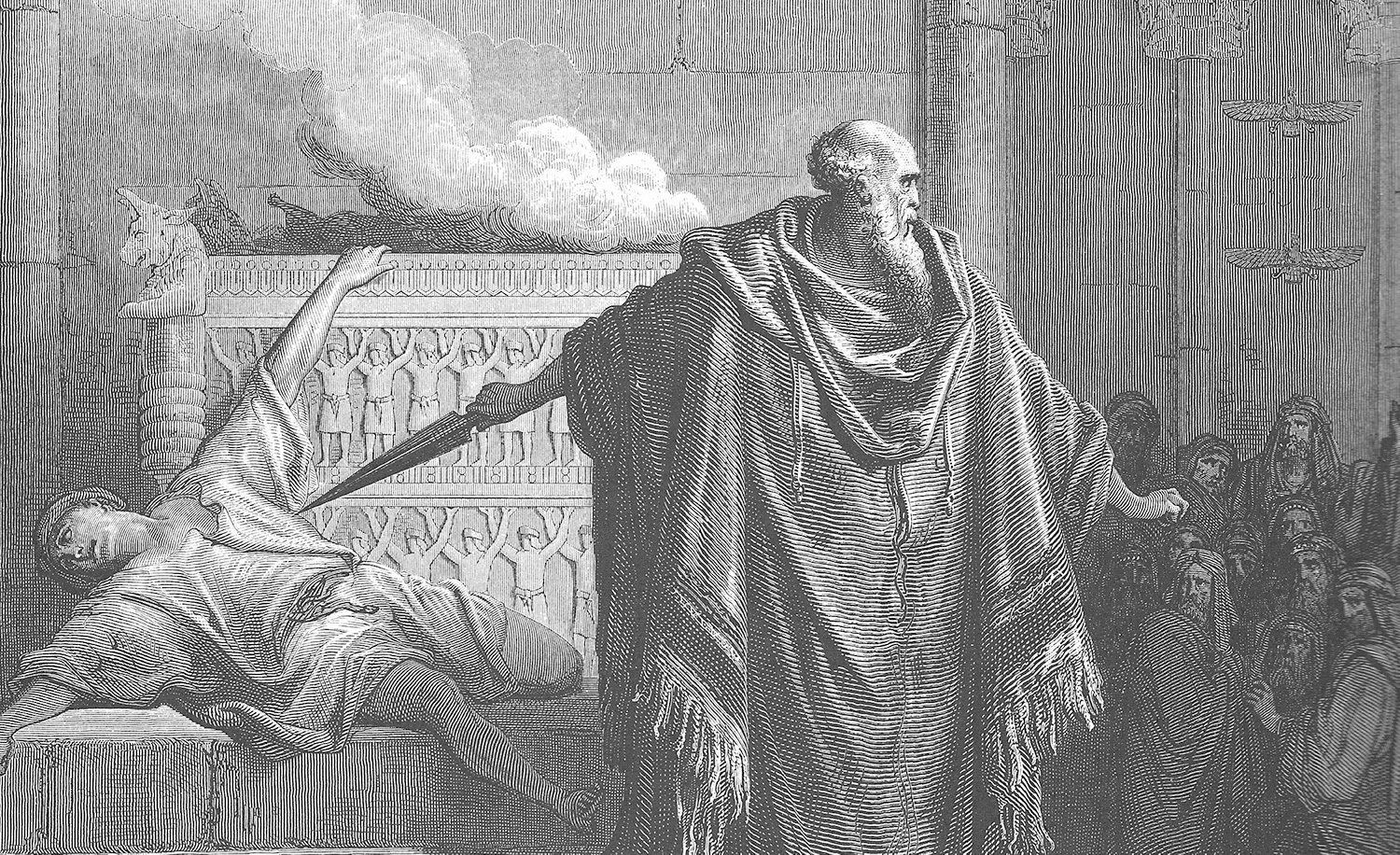
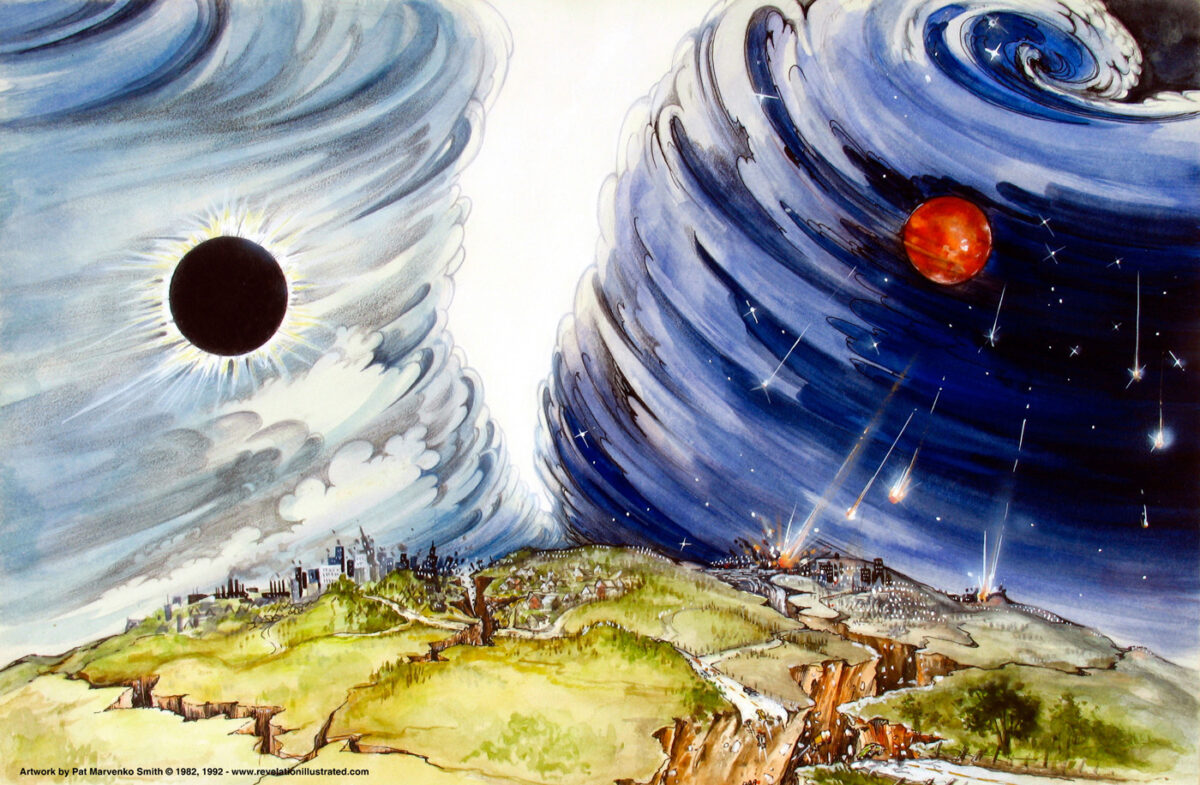

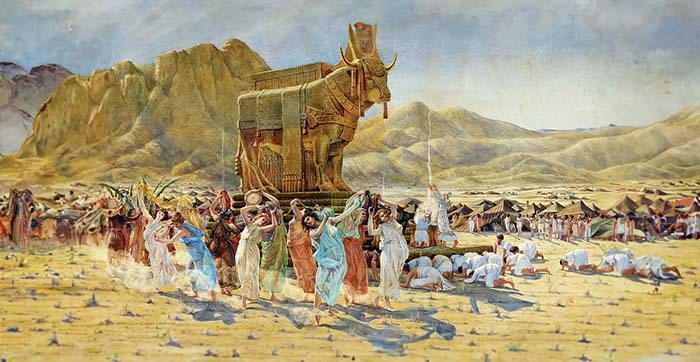
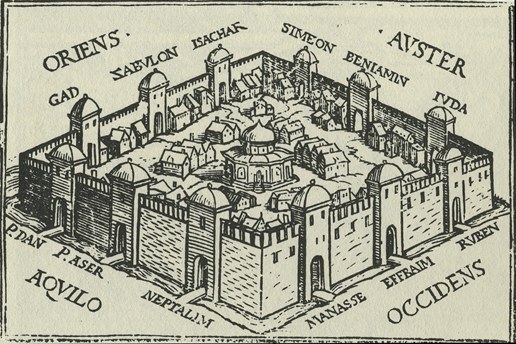
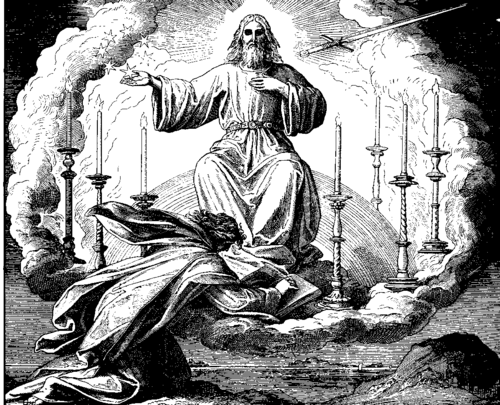
 Garrett Milovich