
The Cosmos in Chaos: Revelation 6, Blood Moons, and Eclipses

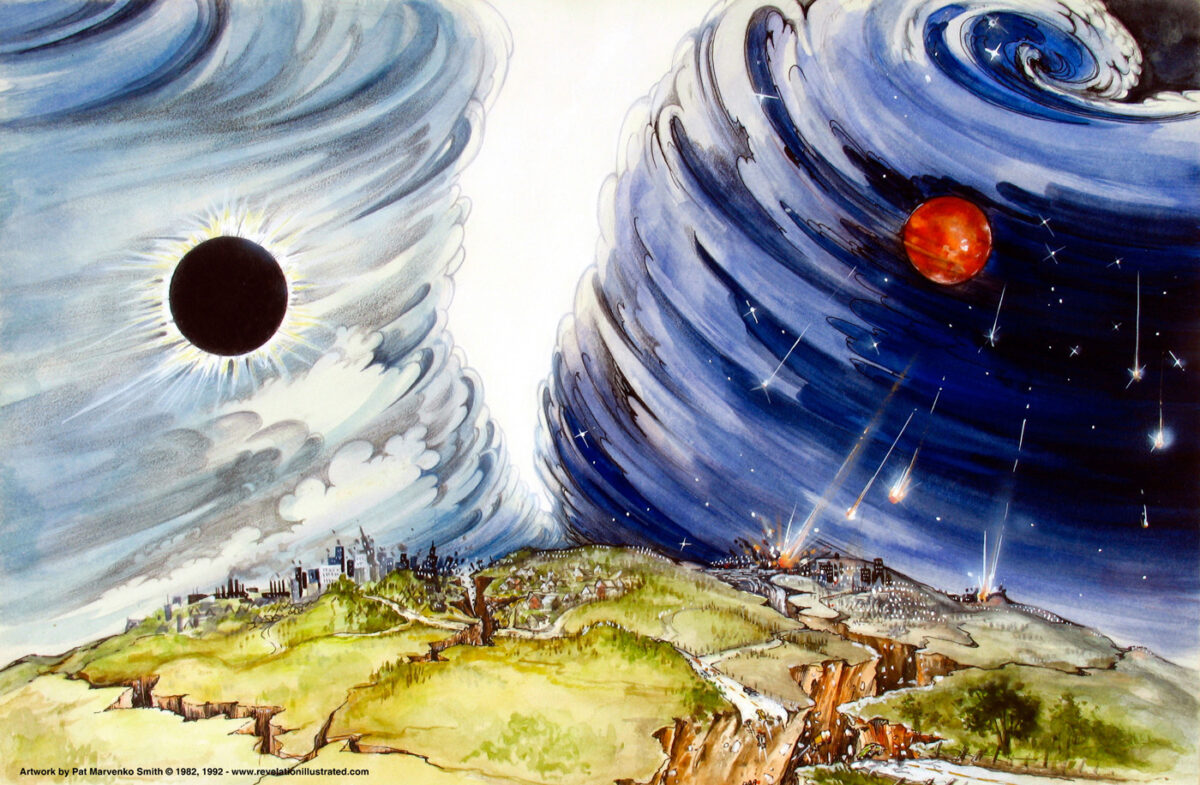
The sixth chapter of Revelation is when things get exciting. It’s got everything: earthquakes, the moon turning red, stars falling out of heaven. And as a result, many Christians assume that a particularly large earthquake or a lunar eclipse (sometimes called a “blood moon”) means the antichrist is on the rise and all hell is about to break loose.

But is this how we’re supposed to read the apocalyptic signs and wonders?

I looked when He opened the sixth seal, and behold, there was a great earthquake; and the sun became black as sackcloth of hair, and the moon became like blood. And the stars of heaven fell to the earth, as a fig tree drops its late figs when it is shaken by a mighty wind. Then the sky receded as a scroll when it is rolled up, and every mountain and island was moved out of its place.” (Revelation 6:12-14)

It sounds like a scene right out of a Hollywood disaster movie about global warming. But every part of this vision had been witnessed multiple times before—in the Old Testament.

All these signs appear throughout the Prophets to signify judgment on a city or nation—typically idolatrous Israel and sometimes enemy nations that persecute God’s faithful:

Behold, the day of the LORD comes, cruel, with both wrath and fierce anger, to lay the land desolate; and He will destroy [Babylon’s] sinners from it. For the stars of heaven and their constellations will not give their light; and sun will be darkened in its going forth, and the moon will not cause its light to shine. (Isaiah 13:9, 10)

Woe to Ariel [that is, Jerusalem], to Ariel, the city where David dwelt!… I will encamp against you all around, I will lay siege against you with a mound, and I will raise siegeworks against you… you will be punished by the LORD of hosts with thunder and earthquake and great noise, with storm and tempest and devouring fire. (Isaiah 29:1, 3, 6)

Thus says the LORD: “Behold, I will throw out at this time the inhabitants of the land… Behold, the noise of the report has come, and a great commotion (Hebrew ra’as and Greek seismos, meaning earthquake) out of the north country, to make the cities of Judah desolate, a den of jackals.” (Jeremiah 10:18, 22)

For in My jealousy and in the fire of My wrath I have spoken: “Surely in that day there shall be a great earthquake in the land of Israel… and all men who are on the face of the earth shall shake ay My presence. And mountains shall be thrown down…” (Ezekiel 38:19, 20, 21)

A nation has come up against My land, strong, and without number… Alas for the day! For the day of the LORD is at hand; it shall come as destruction from the AlmightyThe earth quakes before them, the heavens tremble; the sun and moon grow dark, and the stars diminish their brightness… And I will show wonders in the heavens and in the earth—blood and fire and pillars of smoke. The sun shall be turned into darkness, and the moon into blood, before the coming of the great and awesome day of the LORD. (Joel 1:6, 15, 2:10, 30, 31)

The end has come upon My people Israel; I will not pass by them anymore… Shall the land tremble for this?… And it shall come to pass in that day,” says the Lord GOD, “That I will make the sun go down at noon, and I will darken the earth in broad daylight… I will bring sackcloth on every waist…” (Amos 8:2, 8, 9, 10)

What’s notable about all these prophetic utterances is that they occurred thousands of years ago—and were fulfilled thousands of years ago.

Isaiah prophesied around 700 BC concerning the destruction of Judah—which occurred in 586 BC—and the destruction of Babylon—which occurred in 539 BC. Jeremiah’s ministry coincided with the destruction of Jerusalem and the exile of the Jews, which took place during and shortly after 586 BC. And Joel and Amos preached during the eighth century BC, shortly before the destruction of Israel in 722 BC.

These prophets weren’t warning of a singular “day of the LORD” that would occur in our future—they were warning of various “days of the LORD” that happened thousands of years ago.[1] And with this in mind, it’s clear that these signs aren’t meant to be taken literally. There are no reported earthquakes during these catastrophic events, and the sun and moon are still shining. This is God’s poetic way of saying, “The destruction of your nation will be so cataclysmic, it’ll be as if the sun stops shining and the sky crashes into earth.”  

It’s no surprise that Jesus adopted this same prophetic and poetic language during His ministry:

Immediately after the tribulation of those days the sun will be darkened, and the moon will not give its light; the stars will fall from heaven, and the powers of the heavens will be shaken.” (Matthew 24:29)

The immediate context of this prophecy concerned the destruction of the second temple in Jerusalem (Matthew 24:2, 3). And just as Israel and Judah had collapsed a generation or so after the prophets had declared, just as Babylon and Assyria weren’t turned upside down as the world shifted beneath them, so too did Israel come under God’s judgment in 70 AD.

John’s Revelation was given a few years before the destruction of the second temple. God was giving the inhabitants of Jerusalem one last chance to repent before the city was sacked and the nation destroyed. And the effects of that destruction upon the world were greater than if mountains had literally been thrown into the sea.

So where does this leave us? Are these astronomical signs and wonders simply events of our distant past and otherwise meaningless to us today? Of course not! Regardless of whether your eschatological views believe in a coming tribulation, there will always be empires that rise up against God’s people—and thus days of the Lord will always be necessary. And when they inevitably come, we can take comfort in Joel’s words:

And it shall come to pass that whoever calls on the name of the LORD shall be saved.” (Joel 2:32)


[1] Some of us think that “the day of the LORD” is a coming day related to antichrists, raptures, and the end of the world. Biblically, a “day of the LORD” is a day of judgment on sinners and deliverance for saints. Rightly understood, the destruction of Israel’s first and second temples and the conquering of corrupt nations like Egypt, Babylon, Assyria, Greece, and Israel were all “days of the LORD.”
Revelation 4 and the True Priesthood of God

Revelation 4 kicks off with John seeing and hearing a bunch of crazy stuff:

  • Four creatures full of eyes, six wings, and the faces of a lion, calf, man, and eagle (Rev. 4:7, 8)
  • A throne surrounded by a rainbow with the appearance of an emerald (v. 3)
  • Lightnings, thunderings, and voices everywhere (v. 5)
  • God sitting on the emerald throne, appearing like a jasper and sardius stone (v. 3)
  • Twenty-four elders on twenty-four thrones, clothed in white robes with golden crowns on their heads (v. 4)

And all day and night they worship God together, crying out “Holy holy holy!” (v. 8)

This was quite a sight for John to see. And not surprisingly, every part of this vision had been witnessed before—in the Old Testament.

It’s lifted almost verbatim from Ezekiel 1. The Book of Ezekiel is about a man (Ezekiel) born to be a priest and serve in the temple. However, due to the sins of his unfaithful countrymen, Ezekiel is exiled from the land and all his dreams of ministering before the Lord was dashed… until God appears to him in Babylon and reestablishes his calling. While the physical temple will be destroyed and the unfaithful scattered, Ezekiel will nonetheless serve God and His people as a priest.

The rainbow throne, the crystal, the many-eyed, multi-winged creatures… all of them appear in the opening chapter of Ezekiel—the book of the exiled priest without a physical temple.

But that’s not the only priestly imagery in the book. The emerald, jasper, and sardius stones all appear in Exodus’s instructions concerning the priests’ attire—as well as the robes and the golden crowns (Exodus 28, 39).

Even the lightnings and thunderings come from Exodus 19—at the base of Mount Sinai, where God calls all of His people to be a kingdom of priests before the Lord.

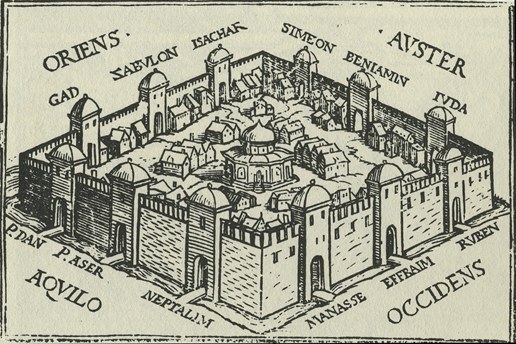
And right in the middle of all this priestly language are the twenty-four elders—the twelve tribes of Israel and the twelve disciples—representing the entirety of God’s people before and after the resurrection, united as one to serve before the Lord as that kingdom of priests God called for at Mount Sinai.

Later in Revelation, the temple will again be destroyed. Those who should be God’s people will instead rebel against the Lord and be scattered once again. Hopes for God’s faithful will seem dashed.

But don’t lose hope. God doesn’t dwell in a temple made with hands (Acts 7:48). And even in exile, God still dwells among His people. Even without a physical temple, God’s people stills minister as kingly priests in the true temple—the Church.

Revelation’s Description of Jesus is More Important than You Think

The epic descriptions of Jesus in the opening chapters of Revelation are more important than you think.

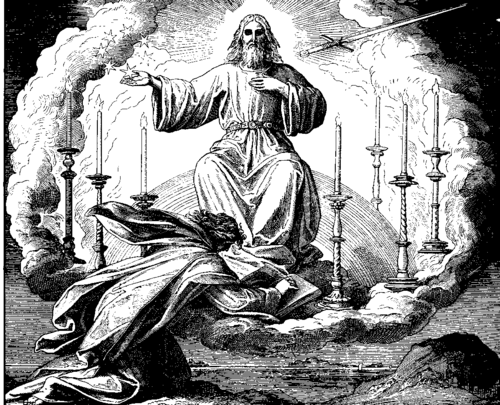
As John opens this book, he describes Jesus in several vivid ways:

  • He is One like the Son of Man (v. 13)
  • He is coming with clouds (7)
  • He is clothed with a garment down to His feet and wrapped about with a golden belt (13)
  • The hair on His head is white like wool (14)
  • His eyes are like a flame of fire (14)
  • His feet are like fine brass (15)
  • His voice is like the sound of many waters (15)
  • A sharp sword is coming out of His mouth (16)
  • His face is like the sun shining in its strength (16)

Yes, Jesus is certainly epic in all His glory. But there’s more to this than just seeing the King of Kings in an awesome way. Every single one of these descriptors is lifted directly from the Hebrew Scriptures.

In Daniel 7, God appears with “the hair of His head like pure wool (v. 9), “coming with the clouds of heaven” (v. 13) as “One like the Son of Man” (v. 13). Later in the chapter, a wicked king arises and “persecutes the saints of the Most High” (v. 25), but God soon overthrows this false ruler and gives an everlasting kingdom to His people (v. 27).

In Ezekiel 9, the people of Jerusalem have forsaken God and turned to rampant idolatry. In response, the glory of God comes upon a man “clothed with a garment down to his feet” with a belt at his side (v. 3). This man then goes “through the midst of Jerusalem, putting a mark on the foreheads of the men” who mourn and repent over the downfall of God’s holy city (v. 4). Soon after, the city is overrun and the temple is destroyed (vv. 5, 7), but those with the faithful mark are protected (v. 6).

In Daniel 10, a heavenly man appears to the prophet with “eyes like torches of fire,” his feet “like burnished bronze,” and “the sound of his words like the voice of a multitude” (v. 6). He informs Daniel that the Kingdom of Heaven were triumphing over the kingdoms of the empires of earth (v. 13) and commanded Daniel to be strong in the days to come (v. 19).

In Isaiah 49, the Suffering Servant of the Lord—Jesus—has His mouth made like a sharp sword (v. 2). He issues forth from His mother’s womb (v. 1) to gather God’s chosen together (v. 5) and then extend God’s salvation to every nation on earth (v. 6), thus “restoring the earth” to its intended glory (v. 8).

In Judges 5, Israel is enslaved to the kings of the surrounding Canaanite nations. The men are too afraid to fight back until, through the inspiration of a life-giving mother in Israel (v. 7), courage is restored and the people are delivered. Peace and rest are returned to God’s people as they cry out, “Let all Your enemies perish, O LORD, let those who love Him be like the sun when it comes out in full strength” (v. 31).

This vision of Jesus Christ isn’t just a cool sight that John saw—it was encoded with powerful imagery for all those who have ears to hear! Before we hear any fantastical prophecies or are given any righteous commandments, the mere sight of God tells us what we can expect:

  • Persecution is coming, but the wicked will be overthrown and God’s people will reign
  • The temple in Jerusalem has forsaken God and will soon be destroyed, but God has marked the faithful for protection
  • A spiritual war is raging, but the battle is already won
  • The gospel is for more than just Israel—the entire earth is being restored to God’s chosen
  • Persevere, don’t lose hope, and trust that God will strengthen His people and give them rest

All these things happened—a generation after Jesus and a few years after this vision was given. The temple was destroyed in 70 AD, but those faithful to Jesus Christ were protected; and soon the most powerful empire on earth bent the knee to Jesus Christ.

But like most things, we see echoes of these events reverberate through history. So we can take hope in this glorious vision of Jesus, just as the early church did. When persecution comes, we patiently endure, knowing we reign alongside our King. When false messiahs arise, we stand on the truth, knowing we carry the mark of Jesus Christ upon our heads. When the gospel is hindered by savage nations, we know that God reigns over all the earth. So we trust in God to strengthen His people and restore us to peace once again.

Reflections on Revelation: Who is 666?

Here is wisdom. Let him who has understanding calculate the number of the beast, for it is the number of a man: His number is 666.” (Revelation 13:18)

Revelation says that 666 is the number of a man. So who is that man? Is it Trump or Biden? Pope Frances or King Charles? Bill Gates or Elon Musk?

I have a different theory. The number 666 is not talking about a forthcoming man. Instead, 666 is a reference to King Solomon.

How can that be? To understand this theory, we need to look back at the history of the kings who reigned over Israel.

Pharaoh, King of Egypt

At the beginning of the book of Exodus, the Israelites have found themselves residing in Egypt after relocating there under the governorship of Joseph. Soon after, there arose a new king over Egypt who did not know Joseph. He was concerned that the Israelites might soon become a threat, so he decided he would “deal wisely [חָכַם – chakam] with them” (Exodus 1:10):

Therefore they set taskmasters [שָׂרֵי מִסִּים – saray mesiym, lit. “rulers of slaves”] over them to afflict them with their burdens [סְבָלָה – subala]. And they built for Pharaoh supply cities [עָרֵי מִסְכְּנוֹת – aray miskunot], Pithom and Raamses.” (Exodus 1:11)

God, of course, did not take kindly to the enslavement of His people, so He brought plagues upon Egypt, resulting in the deliverance of the Israelites and the destruction of the Egyptians.

As the Israelites wandered through the desert towards the Promised Land, God commanded the Israelites that they were to be a nation unlike any of the other nations. They were to be a special treasure above all others, a kingdom of priests and a holy nation (Exodus 19:5-6).

Of course, God knew what lay ahead. One day, God foretold, they would come to Him and say, “Give us a king to judge us like all the other nations” (Deuteronomy 17:14, 1 Samuel 8:5). To ensure that the Israelites would have a good king, God gave three commandments specifically to these future kings. Upon their ascension to the throne, they were to write down these three commandments and read them every single day. And what were those three commandments?

  1. He shall not multiply horses for himself, nor cause the people to return to Egypt to multiply horses;
  2. Neither shall he multiply wives for himself, lest his heart turn away;
  3. Nor shall he greatly multiply silver and gold for himself. (Deuteronomy 17:16-20)

Even though the very first thing God said to mankind was that they were to “multiply” (Genesis 1:28), God demanded that the kings abstain from multiplying in these three areas: Egyptian horses, wives, and silver and gold.

Solomon, King of Israel

Fast forward four hundred and eighty years. Solomon the son of David has been crowned King of Israel, commissioned by his father to build God a temple. God has granted Solomon a wise [חָכָם – chakam] heart, to be used to “administer justice” (1 Kings 3:28). Thus Solomon begins the work of building God a house.

And how does it build this house?

So the LORD gave Solomon wisdom, as He had promised him… Then King Solomon raised up a labor force [מַס – mas, singular of mesiym] out of all Israel; and the labor force [מַס – mas] was thirty thousand men.” (1 Kings 5:12, 13)

Solomon built the temple using the labor of 30,000 slaves—something the pagan king of Tyre called very “wise” [חָכָם – chakam] (1 Kings 5:7). Just as the Egyptians, in an attempt to be wise, enslaved the Israelites to build their temples, so too did King Solomon, in all his supposed wisdom, enslave the surrounding nations to build his temple (1 Kings 5:13, 9:15).

Following in Egypt’s footsteps, Solomon also ordered that storage cities [עָרֵי הַֽמִּסְכְּנוֹת – aray hamiskunot] be built (1 Kings 9:19); he appointed Israelite rulers [שָׂרֵי – saray] over the slaves (1 Kings 9:23); he even appointed Jeroboam (who would soon lead a rebellion against Solomon’s son) to oversee the burden [סֵבֶל – sabel, root of “subala”] of the labor force (1 Kings 11:28).

Rather than lead the people to be a holy nation, set apart from the rest of the nations, Solomon seemed set on emulating the other nations. He apparently took Exodus 1:11—a description of the persecution and enslavement of his people—and used it as a template to establish his own kingdom.

It should then come as no surprise what we read in the following chapters. Solomon begins making alliances with all of the pagan nations that surrounded Israel, intermarrying with idolatrous wives—wives who would soon turn his heart from the LORD. He winds up with an astonishing seven hundred wives and three hundred concubines, mostly from Egypt, Moab, Ammon, Edom, and Sidon; and sure enough, he was soon worshipping Ashtoreth and building temples for Chemosh and Molech (1 Kings 11).

He also began purchasing thousands of Egyptian horses to build up his army, trusting in chariots and horses for protection rather than in the name of the LORD (Psalm 20:7). To build his wealth and strengthen his alliances with the pagan nations, he exported some of these Egyptian horses to the kings of Syria and surrounding nations—the same nations that would soon attempt to conquer Israel (1 Kings 10:28, 29).

Between profiteering from the sale of Egyptian war horses to enemy nations and exploiting slave labor to build his kingdom, Solomon became one of the wealthiest men who ever lived, generating over a billion dollars in silver and gold every year. Far from multiplying justice and righteousness, Solomon was multiplying the precise things he was commanded to abstain from: foreign women, Egyptian war horses, and silver and gold.

And just how much did he make every year?

The weight of gold that came to Solomon yearly was six hundred and sixty-six talents of gold.” (1 Kings 10:14)

That’s right. After building his kingdom—and God’s!—on the backs of slaves, after forsaking the three commandments that God had given him, after abandoning the call to use his wisdom to spread justice and righteousness to the surrounding nations, Solomon instead turned from God’s Word and exploited the gifts he had been given to make himself rich and famous.

And the number assigned to that betrayal was 666.

The Number of the Beast

I don’t think that Solomon was the Antichrist, or that he’s coming back to usher in the last days. Rather, my current reading is that the warnings we were given concerning the number of the beast were meant to prepare us against the spirit that turned Solomon away from the LORD.

Israel was called to be a holy nation, a kingdom of priests, a special treasure set apart from the rest of the world (Exodus 19:5, 6). But instead, Israel decided to fall in line with the sins of every other nation, leading to sexual immorality, greed, human rights abuses, and idolatry.

We too, the Church, are called to be a holy nation, a royal priesthood, His own special people, who will proclaim the praises of Him who called us out of the darkness of this wicked world and into the marvelous light of His kingdom (1 Peter 2:9). Will we walk in that light, or will we follow in the footsteps of Solomon—and Pharaoh before him? Will we give into lust and celebrate sexual perversion in order to fit in with this corrupt generation? Will we betray God’s Word if it will make us a few extra bucks? Will we exploit and dehumanize those made in God’s image to score cheap political points? Will we bow our knee to the gods of this generation? Or will we hold fast to the one true God, regardless of the cost?

Here is wisdom. Choose this day whom you will serve.

P.S.

Isn’t 666 a reference to [Nero/the pope/Nickelback/etc.]?

Sure, I see no reason why that can’t also be true. God, in His infinite wisdom, is able to give prophesies that could have multiple accurate meanings. It’s certainly possible that Revelation 13 could be warning Christians of the dangers of following in the footsteps of Solomon while also warning that various world leaders have already followed in Solomon’s footsteps and are an immediate threat.

It’s also possible that 666 has nothing to do with Solomon. It just seemed like too big a coincidence not to be intentional.