The Second Commandment: Images and Likenesses (TEN COMMANDMENTS)

The second of the Ten Commandments is a prohibition against idolatry, but for some reason God doesn’t just come out and say, “Thou shalt not commit idolatry.” He goes on for 43 words in Hebrew (for comparison, commandments 6, 7, and 8 are two Hebrew words each), spelling out many details about various kinds of idolatry and His own personal nature and so forth.

So, what is God trying to communicate through this commandment?

Let’s take a look at the opening section of the command:

You shall not make for yourself a carved image—any likeness of anything that is in heaven above, or that is in the earth beneath, or that is in the water under the earth; you shall not bow down to them nor serve them…” (Exodus 20:4, 5)

Does any of that language sound familiar? Is there an earlier story in scripture that uses many of these words? As it turns out, much of this language is recycled from the very first chapter of the Hebrew Scriptures.

In the beginning, God made (עָשָׂה, asa) the sky, the sun, the moon, the stars, the beasts of the earth, the cattle, the creeping things that creepeth, and Adam and Eve (Genesis 1:7, 16, 25, 26, 2:18). And when He made Adam and Eve, He made them in His own image, after His own likeness (Genesis 1:26). In that same chapter, we are told how God made the heavens (שָׁמַיִם, shamayim) and everything in them, the earth (אֶרֶץ, erets) and everything that grows upon it, and the waters (מַיִם, mayim) and everything that swims within them. Over and over again, God is using this commandment to remind us of that first chapter of creation.

But why?

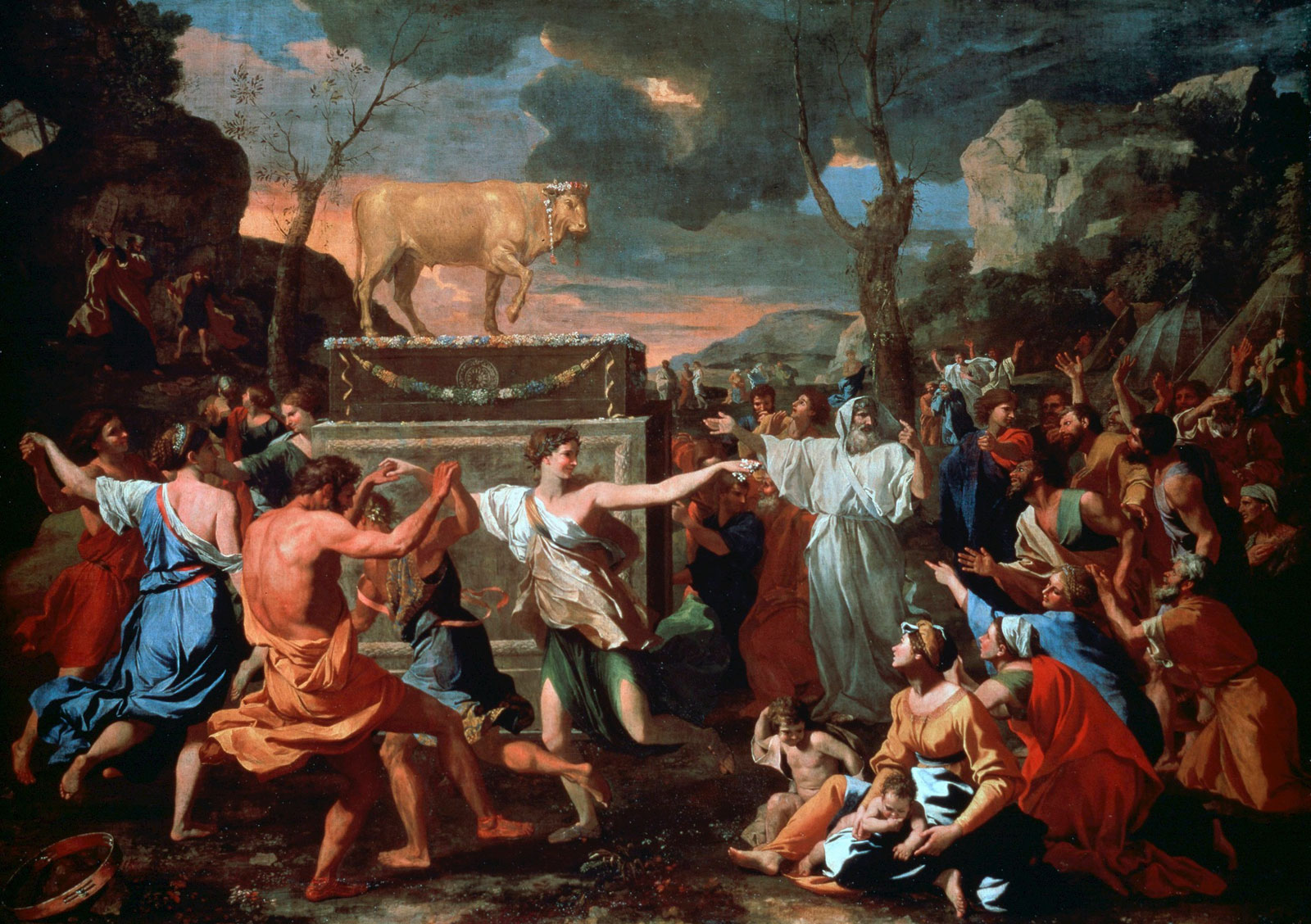
The second commandment isn’t just a law about carving images out of stone or wood or clay. It’s about where we direct our service and worship, and how we direct that service and worship. Do we serve and worship ourselves as creators, do we serve the things we attempt to create for ourselves, or do we worship the One who formed us out of clay?

Thousands of years later, the apostle Paul calls back to this commandment in his letter to the Roman church:

For since the creation of the world [God’s] invisible attributes are clearly seen, being understood by the things that are made… they did not glorify Him as God… changing the glory of the incorruptible God into an image made like corruptible man—and birds and four-footed animals and creeping things… who exchanged the truth of God for the lie, and worshiped and served the creature rather than the Creator… exchanging the natural use for what is against nature.” (Romans 1:20-26)

Paul repeatedly uses this pattern of creation language to reinforce what happens to a man when he gives in to idolatry, when he trades in God for himself, when he exchanges truth for a lie. It doesn’t end with burning incense to a piece of wood. When you choose to reject the obvious reality of God in exchange for a god in your own image, your hearts become darkened and your thoughts become futile (the word for futile is used throughout the LXX in connection with idolatry). When you turn against the God who created nature, you begin to live and act against nature, denying the biological realities of the human race or the humanity of other people based upon the color of their skin. When you worship and serve the creature rather than the blessed Creator, you are given over to a debased mind, and descend into all unrighteousness.

Among the sins Paul lists that flow from idolatry are sexual immorality, covetousness, envy, murder, disobedient to parents, and untrustworthy (Romans 1:29-31). These include the second table of the Decalogue, as well as a host of other trespasses. And they all originate with idolatry, with the choice to reject YHWH and His ways and forge a way for yourself.

God created us in His image, not the other way around. We don’t get to say things like, “I know the Bible says this, but I don’t think God is really like that.” When we do that, we create a false god in our own image, exchanging what we know to be true for a convenient lie.

But if instead will reject the false god of ­­self and worship and serve for the Creator; if we will fulfill our calling to be Image-Bearers of the Most High God as we live out our days among the beasts of the earth and the fowl of the skies and the fish of the waters; if we will exchange our own corruption for the glory of the incorruptible God, we will position ourselves to be remade into the image of the righteous God, and continue our days in His likeness.

Then God saw everything that He had made, and indeed it was very good.” (Genesis 1:31)

Make Haste, O God!

Psalm 70 is a word-for-word copy of Psalm 40. Well, almost. Psalm 40 is a 17-verse prayer that God would “make haste” and deliver David. In the first twelve verses, David explains why God should make haste to deliver him, even expressing his patience in waiting for deliverance.

Psalm 70 completely skips those first twelve verses. Apparently this time around, David was in need of a much hastier deliverance and didn’t have time for explanation or patience. David also makes a few other “changes,” or rather, hasty omissions. He drops unnecessary words from verses 1, 2, and 3. He also drops letters from certain words in verses 4 through 7 which could afford to lose letters while still retaining their meaning (e.g., the five-letter “ezrati” in Psalm 40:17 becomes the four-letter “ezri” in Psalm 40:5, both of which mean “help”).

David’s petition for a hasty deliverance in Psalm 40 might seem presumptuous to some. If so, his petition for an even hastier deliverance in Psalm 70 would be downright offensive. But by preserving both versions in His Bible, God demonstrates that He’s okay with seemingly presumptuous prayers for immediate deliverance. God loves to come through in a pinch, to do what only God can do.

So if you need help, and you need it now, don’t be afraid to let God know.

Make haste to me, O God! You are my help and my deliverer. O LORD, do not delay!” (Psalm 70)

Checed & Emeth

In Genesis 24, Abraham sends his most trusted servant (possibly Eliezer) back to his homeland to find a wife for his son, Isaac. Eliezer is told to find a wife among Abraham’s people, but if he is unable to find a woman (or she refuses to marry Isaac), he will be released from his oath. Essentially, if this doesn’t work out, the line of Abraham might end. This is sort of a big deal.

As you would expect, Eliezer prays to the LORD for help, asking Him to show Abraham “checed” (faithfulness, goodness) and to lead him in “emeth” (truth) (Genesis 24:12, 14, 27, 48).

These two attributes of God appear throughout the Bible, very often together. Jacob prays to God for his checed and emeth (faithfulness and truth) when he returns home to face Esau (Genesis 32:10); David prays for God’s checed and emeth throughout the Psalms (Psalm 40:11); God even reveals Himself to Moses as “the LORD abounding in checed and emeth” (Exodus 34:6).

So Eliezer prays for God’s checed and emeth as he journeys to Nahor, hoping to successfully find Isaac a wife and secure the lineage of Abraham. Sure enough, God delivers. Just as Eliezer finishes praying, he is approached by Rebekah, who is the perfect answer to his prayer. He thanks the Lord, tells her his story, and meets her family.

But then something interesting happens. He asks once more for checed and emeth—but not from God. He asks for it from Rebekah and her family. He asks them to deal faithfully and truthfully with him, to give him a straight answer, to let him know if she would marry Isaac, fulfilling God’s plan for the family of Abraham.

In other words, the plan of God was accomplished by the joining together of God’s checed and emeth and Man’s checed and emeth. God is always faithful and true, and when we respond in faith and truth, God’s plans are realized.

“Let not checed and emeth forsake you. Bind them around your neck, write them on the tablet of your heart, and so find favor and high esteem in the sight of God and man.” (Proverbs 3:3-4)

The First Commandment (TEN COMMANDMENTS)

If a man brings accusation against another man, charging him with murder, but cannot prove it, the accuser shall be put to death.”

This is the first commandment… of the Code of Hammurabi. Other “first commandments” are similar: Sharia Law and the Laws of Eshnunna start by prohibiting theft; The Code of the Nesilim and the Code of Ur-Nammu begin with laws against murder; The Code of the Assura begins by outlawing women from “uttering vulgarity” and the Buddhist Edicts of Ashoka start by protecting animal life.

But the Bible’s Ten Commandments begin in a very different way. Before prohibitions on murder and theft and adultery, God tells us:

You shall have no other gods before Me.

Why does God place this commandment before all of the others? Why is this viewed as more foundational than the other laws? Surely murder is a more offensive crime than polytheism.

The reason this law comes first is that, without establishing this fundamental truth, none of the other laws are binding. Sure, YHWH says that you shall not murder. But Moloch is pleased with human sacrifice, so slaughtering your neighbor won’t be a huge deal if you choose to go with him instead. Jesus condemned sexual immorality. But Ba’al will be glorified when you participate in orgies in the temple, so go ahead and live it up.

If we accept a pantheon of gods and goddesses, there is always another authority who will permit whatever sinful behavior you want to partake in. Even today, when modern Americans aren’t tempted to make sacrifices to pagan statues, we still have a variety of “truths” that we can pick. How often is improper behavior tolerated and celebrated because “he/she/xe/they are just living its truth”? So long as we deny the existence of objective truth—and the existence of one objective Truth-Giver—the remaining nine commandments (and any other biblical, national, or moral law) are optional, subject to our whims.

But if we clear out the pantheon and make room only for one God—for the True God—we now have no other choice but to live for Him and obey His just laws. I can’t choose to go with Ashtoreth or Allah or Oprah or popular opinion instead. Those false gods have been banished, and only YHWH remains.

And if YHWH remains as the only God, then you have a responsibility to follow Him in all areas of your life. So often we adopt this attitude of “putting God first.” But if God is first, that implies that something other than God is second, third, fourth, or fifth. God might come first and be worshipped on Sundays, but career comes second and is worshipped come Monday.

What ends up happening is we create a “God” box and put it out in front, but then have a separate “Family” box and a separate “Work” box and a separate “Me” box, all partitioned away from that first box. God gets first priority on Sunday morning and Wednesday nights, but we keep Him in His box during staff meetings or when we’re out with friends.

But the truth of the First Commandment is that God doesn’t want to be first in our lives; He wants to be only. Every other box—work, friends, family, whatever else—needs to fit into that God box. We pursue our career through the lens of God’s Word. We raise our children to know God. We treat our spouse the way God has commanded us. Every part of our lives is governed by what God has spoken. No other god—Ba’al or Buddha or self—has control over any area of life.

During Jesus’ ministry, He was asked what the first commandment was (Mark 12:28). His answer?

“Hear, O Israel, the LORD our God, the LORD is one. And you shall love the LORD your God with all your heart, with all your soul, with all your mind, and with all your strength.” (Mark 12:29-30)

He was quoting the Shema (Deuteronomy 6), but implicitly commenting on the nature of the First Commandment, the commandment against all forms of polygamy. The LORD our God, the LORD is one. You don’t get a pantheon of preferential deities. There’s only one LORD allowed in your life. And you shall love the LORD with all your heart, soul, mind, and strength. Every part of you, every fiber of your being, belongs to the One God. Don’t hold anything back from Him.

This is the first commandment.

Coats and Goats, Deception and Discernment

Jacob (the youngest son of Isaac), wore his brother’s coat, slaughtered a goat, and deceived his father concerning his identity to steal his brother’s blessing. When Isaac could not discern his identity, he asked Jacob directly who he was. Jacob lied to his father’s face.

A generation later, Jacob’s sons took Joseph (the youngest son of Jacob), stole his coat, slaughtered a goat, and deceived their father concerning the fate of their brother. The sons asked their father to discern what had happened, and then lied to their father’s face.

Some time later, Judah refuses to give Shelah, his youngest son, to marry Tamar. Tamar deceives Judah into an affair, and when he has no goat to pay her with, she takes his coat as a pledge. When she was found to be pregnant, Judah (not realizing she was his mistress) demanded that she be executed. Tamar then presented the coat, and asked Judah to discern who the father was.

All of the elements that had led to their family’s greatest sins were present: the goat, the coat, the deception of the youngest son, the request to discern. Tamar’s life was now in Judah’s hands. Would he deceive the court and have her killed, continuing the family’s legacy of betrayal? Or would he finally come clean and tell the truth?

“She has been more righteous than I,” Judah discerned in front of the crowd, judging himself guilty but justifying Tamar as innocent. Judah had finally broken the pattern. He had committed to the truth and admitted his sin.

This story is likely the reason Judah was chosen to carry the royal line of Israel. More than that, thousands of years later Jesus would be born from the descendants of Judah and Tamar’s affair.

It wasn’t Judah’s self-righteousness that brought the Savior into the world. It was Judah’s acknowledgement of his sin, his declaration of his own unrighteousness, that eventually led to the birth of the Messiah.

“I have not come to call those who think they are righteous, but those who know they are sinners.” (Luke 5)

The Almost Acrostic Psalm

Psalm 25 is an acrostic psalm, meaning each of the 22 verses begins with a different letter of the Hebrew alphabet (which has 22 letters). Well… it’s almost an acrostic psalm. Four verses break the pattern:

  • Verse 2 repeats aleph rather than use beth
  • Verses 5-6 skips over the vav
  • Verse 18 should begin with a shin, but it instead begins with a resh
  • Verse 22 begins with an extra pei

Given that this psalm is *almost* an acrostic, the author seems to be drawing our attention to the verses that break the pattern. So, what do those verses say?

  • Let not my enemies triumph over me
  • You are the God of my salvation
  • Forgive all my sins
  • Redeem Israel out of all their troubles

All of these verses are about salvation! And David (by the Holy Spirit) wants us to focus on God’s deliverance from our troubles and our enemies throughout this psalm.

But that’s not all. If you put the three missing letters together, they spell the word “hell.” And if you put the three extra letters together, they spell “healer.” In other words, while bringing our attention to God’s ever-present salvation, God has removed hell and replaced it with healing.

He truly is the God of our salvation.

“To You, O LORD, I lift my soul. O my God, I trust in You.” (Psalm 25)

Who Can Find a Virtuous Woman?

In Proverbs 31, Solomon famously asked, “Who can find a virtuous woman?” When you flip through the pages of the Scriptures, you’ll discover that only one Eshet Chayil—virtuous woman, woman of valor—is to be found: Ruth, the great-great-grandmother of Solomon.

There are many qualities we could try to attach to Ruth to figure out why she is lauded as a woman of valor. She was courageous, faithful, generous, and wise; she feared the LORD and raised her children and grandchildren to fear Him as well; she obeyed God, even when it was inconvenient, and found a way to bring God’s Word to pass in her family, even when the cards were stacked against her.

But Solomon didn’t ask, “What makes a woman virtuous?” He asked, “Who can find a virtuous woman?” And the answer, at least in this case, is Solomon’s great-great-grandfather: Boaz. Boaz found his virtuous woman, redeemed her, married her, and loved her.

And how does the Bible describe Boaz? At the very first mention of Boaz in the Scriptures, he is described as a “Ish Gibor Chayil”: a man of mighty valor, an incredibly virtuous man. Read through the story of Boaz and Ruth and you’ll find that he, too, was courageous, faithful, generous and wise. He, too, feared the LORD and taught His family to do so as well. And He obeyed God, even when it was inconvenient, and found a way to bring God’s Word to pass in his family.

So, who can find a woman of valor? The primary answer the Bible gives us is, “A man of mighty valor.”

The “Older” Shall Serve the “Younger”

While Rebekah was pregnant with twins, God appeared to her and said,

“Two nations are in your womb,
Two peoples shall be separated from your body.
One people shall be stronger than the other,
And the older shall serve the younger.” (Genesis 25:23)

We often interpret this in light of what we know will eventually come to pass between the two brothers: Since we know the younger brother Jacob will end up with his older brother’s birthright and blessing, this heavenly declaration must be prophesying those events. “The older (Esau) will serve the younger (Jacob)” by forfeiting his inheritance. Thus, Esau is the loser of the prophecy because he serves, while Jacob is the winner because he is served.

I think this interpretation is wrong.

For one, this verse doesn’t actually say that “the *older* shall serve the younger.” The word “older” is the Hebrew word “rab,” which actually means “greater.” And of the 458 times it appears in the Hebrew Scriptures, it’s only translated “older” in this passage. In fact, if the author meant to say “older,” there’s another word he could have chosen. The word “gadol” means “older,” as we see in Genesis 27:1, where Isaac refers to Esau as his “beni ha-gadol”: “my older son.”

In my opinion, a better translation of the end of Genesis 25:23 would be, “…and the greater shall serve the lesser.” When read this way, the passage is ambiguous as to who is the “greater” and who is the “lesser.” So… who was the greater one?

At first, we might think that the greater one was Jacob. After all, he outsmarted his brother and ended up with the blessing, right? Well… it’s not actually so clear. It’s true that Jacob deceived his father and brother in order to receive his father’s blessing (Hebrew berakah). But twenty years later, when Jacob returned home to face his brother, he returns the berakah, saying, “Please, take my blessing” (Genesis 33:11).

Okay, so maybe Esau is the greater one. He is stronger than his brother, after all. Additionally, after he meets up with his brother after twenty years apart, he tells Jacob that he doesn’t need his brother’s gifts, for “I am great (rab) enough” (Genesis 33:8). Right there, Esau declares himself to be the great one. Case closed, problem solved.

Except… Esau isn’t the only brother who is called great. After living in exile for twenty years, the Bible calls Jacob “exceedingly great” (rab) (Genesis 30:43).

So, both brothers are called great (rab), both brothers were increased greatly, and the blessing changes hands several times and doesn’t really seem to play into this all that much. Which one is the “greater” one? That original prophecy tells us:

“The greater *shall serve* the lesser.”

The greater one is the one who serves.

And with that in mind, which of the two brothers served? During the twenty years that they were separated, we read eleven times that Jacob served (abad) his uncle Laban. This service to his uncle led directly to Jacob becoming great, both in terms of finances, family, and influence. And then when Jacob and Esau finally reunite, Jacob calls himself Esau’s servant (ebed) five times. Those twins spent years and years seeking greatness by trying to steal the inheritance from one another. But finally, Jacob began to seek greatness *through service*.

You find this dynamic live on through their descendants. Esau’s people became the Edomites, while Jacob’s people became the Israelites. After 400+ years in slavery, the Israelites asked permission to pass through the Edomite’s land. The Edomites chose not to serve, refusing them entry into their land (Numbers 20:21).

Despite this poor treatment, God wrote it into the Israelites’ legal code that the Edomites would always be welcome to join the congregation of Israel and worship the One True God beside them, “for he is your brother” (Deuteronomy 23:7, 8). The Israelites were commanded to serve their brother Edom.

So often we read Genesis 25:23 and assume that the one who “serves” is the one that gets the short end of the stick, but the opposite is true. The one who “serves” is the one who is considered “great.”

And this interpretation of greatness and service fits much better within the whole narrative of scripture. The very first usage of the word “service” in the Bible (abad) is found in the Garden of Eden, where Adam was given the important task of abading the garden—of serving it, of tilling it. Hundreds of years later, Moses demands that Pharaoh “let God’s people go,” that they may abad Him. After their salvation from Egypt, God gives the priests and Levites the important job of abading Him in the tabernacle. And throughout the prophets, the future Messiah is called the ebed of the LORD—the Servant of God. Service is what God’s people are called to, and serving God and others is what makes us great in the eyes of the LORD.

And thousands of years later, we see this play out between two opposing kings. King Herod was an appointed “king of the Jews.” He was rich, ruthless, and wanted to be served. He considered himself to be so great that he gave himself the title, “Herod the Great.” And did I mention that he also was an Idumaean—an Edomite, a descendant of Esau.

But there was another King of the Jews. This One came not to be served but to serve. This One became poor that we might be made rich. This One bore our sicknesses that we might be healed. This One who knew no sin became sin, that we might be made the righteousness of God. This One—an Israelite, a descendant of Jacob—was the True King, the Servant King, the Great King.

And this Great Servant King taught all who would listen how to achieve greatness as well, by echoing the words He had spoken to Rebekah thousands of years earlier:

“He who is greatest among you shall be your servant.” (Matthew 23:11)

What is Love? (Church Basement)

Love. It’s what God is. It’s what we’re supposed to walk in. And depending who you ask, it’s also a battlefield, an open door, and all you need. But… what is it? What is love?

Nowadays most people would say that love is being nice, or maybe tolerance or acceptance. Some dictionaries say it’s a feeling of attachment, or passionate affection.

And a mistake many Christians make is using today’s cultural understanding of love and applying that to scriptures about love, rather than getting our definition of love from the Bible and living that out in the world.

So, what does the Bible say about love?

A few things, actually. Throughout Jesus’ ministry, people would ask Him, “What is the great(est) commandment in the law?” and His answer was always the same:

“You shall love the Lord your God with all your heart, with all your soul, with all your mind, and with all of your strength.” “And you shall love your neighbor as yourself.”

Now these weren’t laws that He just made up on the spot. No, these laws were given thousands of years earlier, when God gave them to Moses on Mount Sinai. These are established laws from the Hebrew Scriptures.

Now notice the connection between love and God’s law. Jesus says that when you’re walking in love, you’re obeying laws that God has commanded. And this connection between walking in love and living according to the law continues throughout the Bible.

Writing to the Romans, Paul says, “Owe no one anything except to love one another, for he who loves another has fulfilled the law.” You shall not murder, you shall not steal, you shall not lie, you shall not covet. Paul says these are all summed up in this saying, “You shall love your neighbor as yourself.”

Paul is making the same connection between love and law. When you walk in love, you’re obeying God’s law. And conversely, when you disobey God’s law, you’re not walking in love.

James says the same thing, writing, “If you really fulfill the royal law according the Scripture, ‘You shall love your neighbor as yourself.'” To love is to fulfill—to obey—God’s law.

Even John, Jesus’ beloved disciple, says the exact same thing. In one of his letters, he writes, “This is love, that we walk according to His commandments.” In other letter, he says, “This is the love of God, that we keep His commandments.” Then he adds, “And His commandments are not burdensome,” as if to silence the objectors and say, “Guys, you can do this. You can walk in love.”

And finally, Jesus adds His agreement to James, John, and Paul. He tells His followers—He tells you and me—“If you love Me, keep My commandments,” and “He who has My commandments and keeps them, it is he who loves Me.”

Love isn’t some alternative to obeying God. Love is obeying God. Love is doing what God has said to do. To love someone is to treat them how God has commanded you to treat them. Love is obedience to God and to His Word.

And when you apply God’s standard of love to the world, you find that there are plenty of things that society says are loving that aren’t really all that loving.

Stealing something from one person and giving it to someone in need isn’t real love, because stealing is against God’s law.

Having sex with your girlfriend because you are in love isn’t real love, because sex outside of marriage is against God’s law.

Telling someone that their sin is okay because you don’t want to hurt their feelings isn’t real love, because lying is against God’s law.

If your supposed love is causing you to disobey God, then it’s not real love, because the most loving thing you can do in any given situation is to do exactly what God has said to do.

And real quick, I just want to point out that this isn’t a license to call people out like a tool. Ephesians 4 says our words should be used for godly edification and imparting grace, so if you’re not speaking words of grace, you’re not speaking in love.

So what is love, truly? It’s not what you see coming out of Hollywood. It’s not what you hear on the radio or what you read in Time Magazine or what you see trending on the internet. It’s what you find in the Holy Scriptures, revealed and commanded by the perfect and loving God.

Love is obedience to God’s Word. Love is keeping His commandments. Love is doing what God has said to do. And love is what God has called each and every one of us to do. So let’s get started.

Have a great week, and remember, you’re greater than you realize.

Mount Moriah (Church Basement)

“Love.” I’d think we could all agree that “love” is a relatively important topic when it comes to God, right? But do you know where the word “love” first appears in the Bible? Yeah, didn’t think so.

It actually shows up for the first time in Genesis 22, when God says to Abraham, “Take now your son, your only son Isaac, whom you LOVE, and go to the land of Moriah, and offer him there as a burnt offering…”

So Abraham and Isaac set out for a mountain in the land of Moriah to make this sacrifice. Abraham brings a knife and a fire, while Isaac carries the wood. It’s a three-day journey, and on the third day Isaac looks around and realizes that Abraham forgot to bring a lamb. Apparently Isaac doesn’t know what’s about to happen. So he asks his dad, “Hey, uh… where’s the lamb?”

And Abraham says to Isaac, “God will provide for Himself the lamb, my son.” Now there’s two ways to read this: “God will provide the lamb, I say to you, my son.” Or, “God will provide the lamb, and the lamb is my son.” Frankly, either one fits, and both apply, so take it how you want.

Now we all know what happens next: Abraham binds Isaac on the altar—presumably with Isaac’s permission, as Abraham is well over a hundred years old and Isaac is probably around 20.

But before Abraham can lay a hand on the boy, God stops him and tells him, “Because you have not withheld your only son, in your seed all the nations of the earth shall be blessed.” Abraham lifts his eyes and sees a ram caught in a bush, and sacrifices the ram instead of his son.

And all of this takes place on a mountain in Moriah. Now the first time I read this story when I was 17, that place stuck out to me. “Mount Moriah.” I had heard of it before. And then I realized: That was the same place… where Gandalf died in Lord of the Rings! He died while fighting the balrog on Mount Moria.

But that got me thinking: Does Mount Moriah show up anywhere else in scripture? And it turns out, it does. The Hebrew word “Moriah”—which means “chosen by Yahweh”— shows up in one other place.

In 2 Chronicles, we are told that “Solomon began to build the house of the LORD at Jerusalem on Mount Moriah.” The temple, of course, was the center of the Jewish faith, and the place where all the sacrifices—including the twice-daily burnt offering—were to be made.

So you have this mountain—Mount Moriah—where Abraham was commanded to make a sacrifice, which resulted in a promise that all of the people of the earth would be blessed by a descendant of Abraham. And a thousand years later, that is the exact location where Solomon—a descendant of Abraham—builds God’s temple, where all of the sacrifices were made on behalf of the people.

That’s cool, right? But does Mount Moriah show up anywhere else? Well we don’t see the word “Moriah” again, but there is a hint in 2 Chronicles. We just read that Solomon “built the house of the LORD on Mount Moriah,” but there’s more to the verse.

“…Mount Moriah, where the LORD had appeared to his father David… on the threshing floor of Ornan the Jebusite.” So David had been to Moriah too! But what exactly did David do there?

Looking back in 1 Chronicles, we read that David was “moved by satan” to lead the nation in what is described as an “repulsive” sin that brings “guilt upon Israel.” As a result, a plague falls upon the land, which threatens to destroy the people of Jerusalem.

We then read that David “lifted his eyes and saw the angel of the LORD standing between earth and heaven, having in his hand a drawn sword stretched out over Jerusalem.”

And what does David do? He falls to his knees and declares, “Let Your hand, I pray, O LORD my God, be against me and my father’s house, but not against Your people that they should be plagued.” David begs for the punishment to fall on him and his descendants, and for the people to be spared.

God then commands David to “erect an altar to the LORD on the threshing floor of Ornan the Jebusite.” Where is Ornan’s threshing floor? On Mount Moriah, in the exact place where Solomon would build the temple a generation later. David buys the place from Ornan, builds an altar, and makes a sacrifice there. Then God answers him “from heaven by fire on the altar,” and the destroying angel “returned his sword to its sheath.”

So in the same place where Abraham was commanded to sacrifice his descendant to bring blessings upon the earth, David asks God to forgive the people of the destruction they deserve and punish his descendant instead, and then David makes a sacrifice on the altar. The same place where, a generation later, all of the sacrifices will be made. All of these events take place on Mount Moriah.

So with all of this context in mind, I have a question for you: Where do you think Jesus was crucified? On Mount Moriah. On the same mountain where sacrifices were made for hundreds of years, where Solomon built his temple, where David stood in the gap, where Abraham took his son. All of these events took place in the exact same spot!

Think about all the meaning packed into that location. Abraham had journeyed three days to get to Moriah while his son carried wood on his back, where he declared that God would provide his Son—his only Son, his beloved Son—as a lamb for sacrifice, and that all the nations of the earth would be blessed as a result.

Jesus—God’s beloved Son—is also called the Son of Abraham, the Lamb of God, and after He carried a wooden cross and was crucified on Mount Moriah and spent three days in the earth, His resurrection brought the blessing of Abraham upon all who would believe.

David stood on Mount Moriah—between heaven and earth—and implored God that the people should be spared from their justified destruction, and that the punishment for their sins should fall upon David and his descendant instead.

Jesus—the Son of David—was marched to the exact same location—between heaven and earth—and took our collective punishment upon Himself, that we might be spared our deserved wrath of God.

Solomon built the Temple on Mount Moriah, where his father had assuaged the wrath of God a generation earlier. Literally hundreds of thousands of sacrifices were made there, daily postponing the punishment for the sins of mankind.

And after a thousand years of sacrifices on that same spot, God finally provided His Lamb. The Son of David, the Son of Abraham, the Son of God—He carried a wooden cross up that mountain, where they nailed Him to it and raised Him up before heaven and earth. And with His last breath, He declared, “It is finished,” and gave up the spirit.

All that had happened on Mount Moriah before had been leading up to this exact moment. The promise made to Abraham, the forgiveness extended to David, the offering made by Solomon—it was finally finished. Fulfilled in the same place where it started. Through Christ, the seed of Abraham, all the nations of the earth would finally be blessed.

And all of this takes place in the very first place where we were introduced to biblical love.

I don’t know about you, but this blows my mind. Like, God is so incredibly good in all of this. But stuff like this is so easy to miss. If you don’t pay attention to where these stories take place, you’ll miss all of this meaning and goodness.

I once heard it said, “Geography is theology.” The Bible is 1,189 chapters. God wouldn’t waste His words telling us where these things take place if they weren’t important. The geography of the Bible is there for a reason, and when we make an effort to understand not only what’s happening but where it’s happening, God can show us things we never knew were there.

So next time you’re reading the Bible and God goes out of His way to tell you where the action is happening, take a minute and look it up. You never know what you’ll find.

Have a great week, and remember, you’re greater than you realize.